What is a mortgage in Canada? Simply put, it is a loan used to buy a home, where the home itself secures the loan. So if you stop paying, the lender can eventually take the property. However, mortgages in Canada come with their own vocabulary and rules, which can make them confusing at first.
So this beginner’s guide explains what a mortgage is, how it works in Canada and the key terms you need before you talk to a lender.
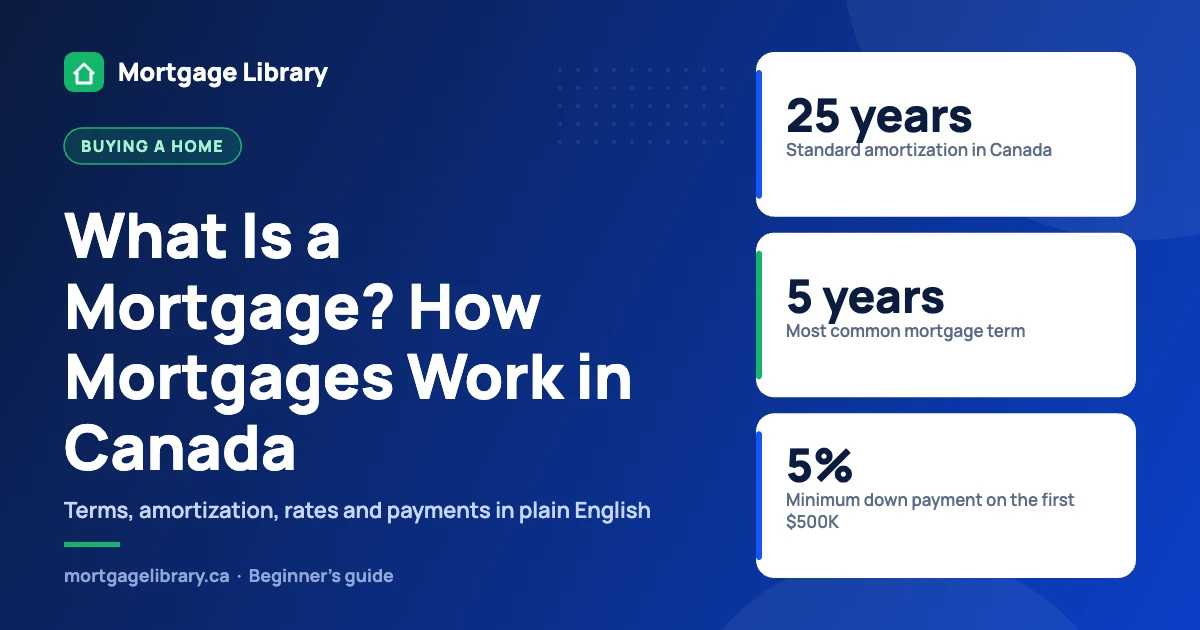
What is a mortgage in Canada, in plain English?
When you buy a home, you usually pay part of the price yourself, which is your down payment. Then a lender, such as a bank or credit union, lends you the rest. In return, you also agree to repay the loan plus interest in regular payments.
Because the loan is secured by the home, lenders can offer much lower rates than on car loans or credit cards. As a result, a mortgage is usually the cheapest way to borrow a large sum.
The key parts of a mortgage in Canada
Mortgage terms you need to know
| Term | What it means |
|---|---|
| Principal | The amount you borrow. |
| Interest rate | What borrowing costs, shown as a yearly percentage. |
| Term | How long your rate and conditions are locked in, often 5 years. |
| Amortization | The total time to pay off the loan, often 25 years. |
| Fixed or variable | Your rate either stays the same or moves with prime. |
| Open or closed | Open mortgages allow early repayment without a penalty, but closed ones do not. |
| Insured or uninsured | Default insurance is required when you put down under 20%. |
For more definitions, also keep our mortgage glossary handy.
Term vs. amortization: the Canadian twist
However, this is the part that surprises many people. In Canada, you rarely lock in a rate for the whole life of the loan. Instead, you choose a term, usually between one and five years. When it ends, you renew at the current rate, or you switch lenders.
The life of a typical 25-year mortgage
- Year 0
Buy and borrow
First, you choose a 5-year term within a 25-year amortization.
- Year 5
First renewal
Then you renew at the rates of the day, or switch lenders.
- Years 10 to 20
More renewals
Each renewal is also a new chance to negotiate, prepay or change terms.
- Year 25
Mortgage-free
Finally, the last payment clears the loan.
Consequently, your rate can change several times over 25 years. That is why understanding mortgage renewals matters as much as getting a good rate the first time.
How mortgage payments work
Each payment covers interest first, and the rest reduces your principal. So at the start, most of your payment goes to interest. Over time, however, the balance shrinks, so more of each payment pays down the loan.
Yearly interest vs. principal on $500,000 at 4.29%
To see the math step by step, read how to calculate mortgage payments. Alternatively, try the calculator below.
What is a mortgage going to require from you?
Generally, Canadian lenders follow a few national rules. Before you apply, it helps to know them:
- A down payment: at least 5% on the first $500,000 of the price, as covered in our minimum down payment guide.
- Mortgage insurance: required when you put down less than 20%, as explained in our CMHC insurance guide.
- The stress test: you must qualify at a higher rate than you will pay, according to OSFI Guideline B-20.
- Income and credit checks: lenders also review your income, debts and credit history.
How to get a mortgage in Canada
From first step to keys in hand
Check your budget
Work out how much mortgage you can afford before you shop.
Get pre-approved
A pre-approval confirms your budget and also holds a rate.
Compare lenders
Then get quotes from your bank and a mortgage broker.
Get final approval and close
Once the lender approves the property, your lawyer then completes the purchase.
Finally, remember that the rate you choose matters just as much as the home. So compare offers, and read our fixed vs. variable guide before you decide.
Frequently asked questions
A mortgage is a loan used to buy a home, secured by the home itself. You then repay it with interest in regular payments, usually over 25 years in Canada.
The term is how long your rate is locked in, often five years. In contrast, the amortization is the total time to pay off the loan, often 25 years, so you usually renew several times.
At least 5% on the first $500,000 of the price and 10% on the portion up to $1.5 million. However, homes of $1.5 million or more require 20% down.
You renew with your current lender, or you switch to a new one. The new rate applies for the next term, and the process repeats until the loan is paid off.
Sources: FCAC: Choosing a mortgage · FCAC: Renewing your mortgage · OSFI Guideline B-20