Learning how to calculate mortgage payments takes the mystery out of every rate quote you see. It also helps you spot a bad deal, compare terms and plan prepayments. However, there is a twist: Canadian fixed-rate mortgages use a different compounding rule than most online formulas assume.
So below you will find the exact formula, the Canadian adjustment, a step-by-step example and a table you can use as a quick reference.
The formula to calculate mortgage payments
Every fixed mortgage payment comes from the same amortization formula, so the math never changes. In other words, it finds the level payment that pays off the loan, with interest, over a set number of payments.
The mortgage payment formula
M = P × i ÷ (1 − (1 + i)−n)
| M | Your regular mortgage payment |
|---|---|
| P | The amount you borrow (the principal) |
| i | The interest rate per payment period |
| n | The total number of payments (years × 12 for monthly) |
Why Canadian mortgage payments are calculated differently
In Canada, the Interest Act requires fixed-rate mortgages to state interest compounded semi-annually, not monthly. As a result, you cannot simply divide your annual rate by 12. Instead, you convert it like this:
At first, the difference looks tiny. Still, on a $500,000 loan it lowers the payment by roughly $10 a month compared with monthly compounding. Also note that many variable-rate mortgages compound monthly, so check your mortgage agreement when you calculate mortgage payments on a variable loan.
Step by step: calculate mortgage payments on $500,000
Example: $500,000 at 4.29% over 25 years
Convert the rate
(1 + 0.0429 ÷ 2)^(1/6) − 1 = 0.003543, or 0.3543% per month.
Count the payments
25 years × 12 = 300 monthly payments.
Plug into the formula
M = 500,000 × 0.003543 ÷ (1 − 1.003543−300).
Get your payment
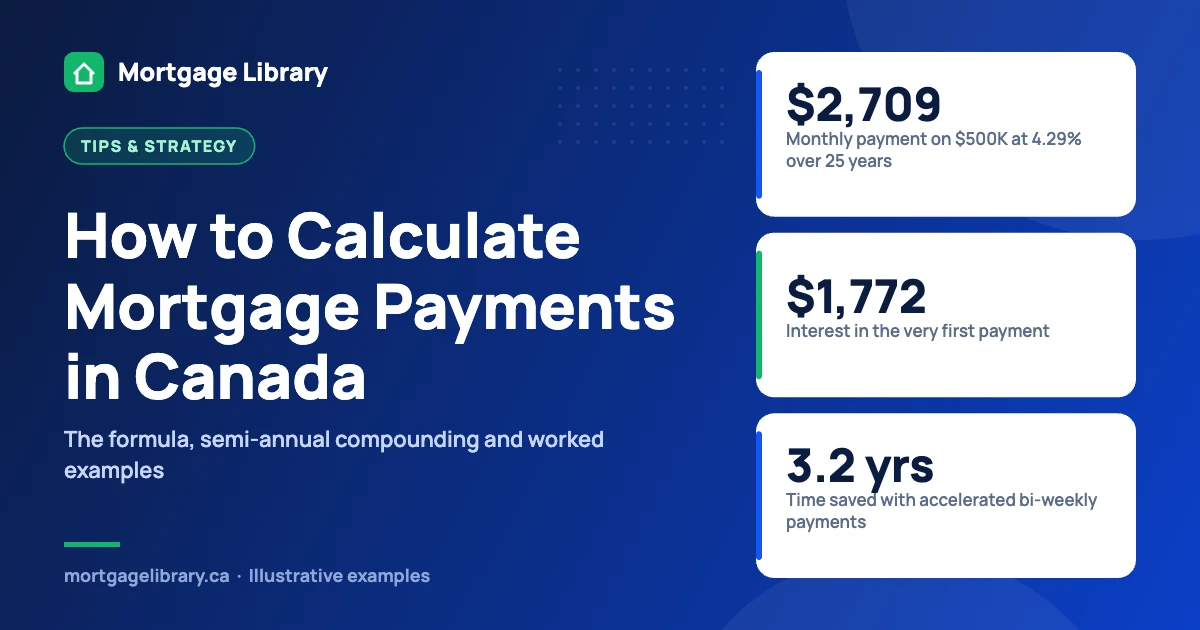
M ≈ $2,709.29 per month.
Next, you can split that payment into interest and principal. In the first month, interest is $500,000 × 0.3543%, or about $1,772. So only about $937 of your first payment actually reduces the balance.
Where your first $2,709 payment goes
In fact, over the first five years you would pay roughly $100,000 in interest, and your balance would fall to about $437,000. That is why the rate you negotiate matters so much.
Quick reference: monthly mortgage payments
When you want a fast estimate, use this table. It also uses semi-annual compounding and a 25-year amortization.
Monthly payment by mortgage amount and rate
| Mortgage amount | 3.99% | 4.29% | 4.99% |
|---|---|---|---|
| $400,000 | $2,102 | $2,167 | $2,324 |
| $500,000 | $2,627 | $2,709 | $2,905 |
| $600,000 | $3,153 | $3,251 | $3,486 |
How payment frequency changes the math
Most lenders also let you pay weekly or every two weeks. Regular bi-weekly payments simply spread the monthly total across 26 payments, so they barely change your costs. Accelerated bi-weekly payments, however, are half the monthly payment paid 26 times a year. As a result, you make one extra monthly payment every year.
Monthly vs. accelerated bi-weekly ($500,000 at 4.29%)
Monthly
- $2,709 × 12 payments
- Paid off in 25 years
- About $312,800 in total interest
Accelerated bi-weekly
- $1,355 × 26 payments
- Paid off in about 21.8 years
- About $266,700 in total interest
- Saves roughly $46,000
What happens if I pay an extra $100 a month?
Extra payments go straight to principal, so they cut interest right away. For example, adding $100 a month to the $500,000 mortgage above would pay it off about 18 months sooner and save roughly $21,700 in interest. Before you start, though, check your prepayment privileges, because most closed mortgages cap how much extra you can pay each year. For an easy method, also see how rounding up your payments works.
Other costs to add when you calculate mortgage payments
Of course, your mortgage payment is only part of the monthly cost of owning a home. So when you budget, also include:
- Property taxes, which some lenders also collect with your payment.
- Mortgage default insurance when you put down less than 20%. The premium is usually added to your mortgage, so it raises the payment.
- Home insurance, which lenders also require.
- Condo fees, heating and utilities, too.
Finally, remember that lenders qualify you at a higher rate than the one you pay. To see how that also affects your budget, read how much mortgage you can afford and our stress test guide.
Frequently asked questions
First, convert the annual rate to a monthly rate with semi-annual compounding: (1 + rate ÷ 2) to the power of 1/6, minus 1. Then use the formula M = P × i ÷ (1 − (1 + i) to the power of −n), where n is the number of payments.
At 4.29% over 25 years, the payment is about $2,709 a month. At 4.99% it rises to about $2,905, while at 3.99% it falls to about $2,627.
Because Canadian fixed-rate mortgages compound semi-annually, while most US calculators assume monthly compounding. As a result, the Canadian payment is slightly lower at the same quoted rate.
Yes. Because you make the equivalent of one extra monthly payment each year, a $500,000 mortgage at 4.29% would be paid off about three years sooner and save roughly $46,000 in interest.
Sources: Interest Act (Canada) · FCAC: Mortgage calculator · FCAC: Paying off your mortgage faster