Should you pay down your mortgage or invest the money instead? It is one of the most common money questions Canadian homeowners ask, especially at tax time. Both choices build wealth. However, one offers a guaranteed return, while the other offers higher potential growth with more risk.
So this guide compares prepaying your mortgage with investing in an RRSP or TFSA, using real numbers, and it gives you a simple framework to decide.
How to think about pay down mortgage or invest
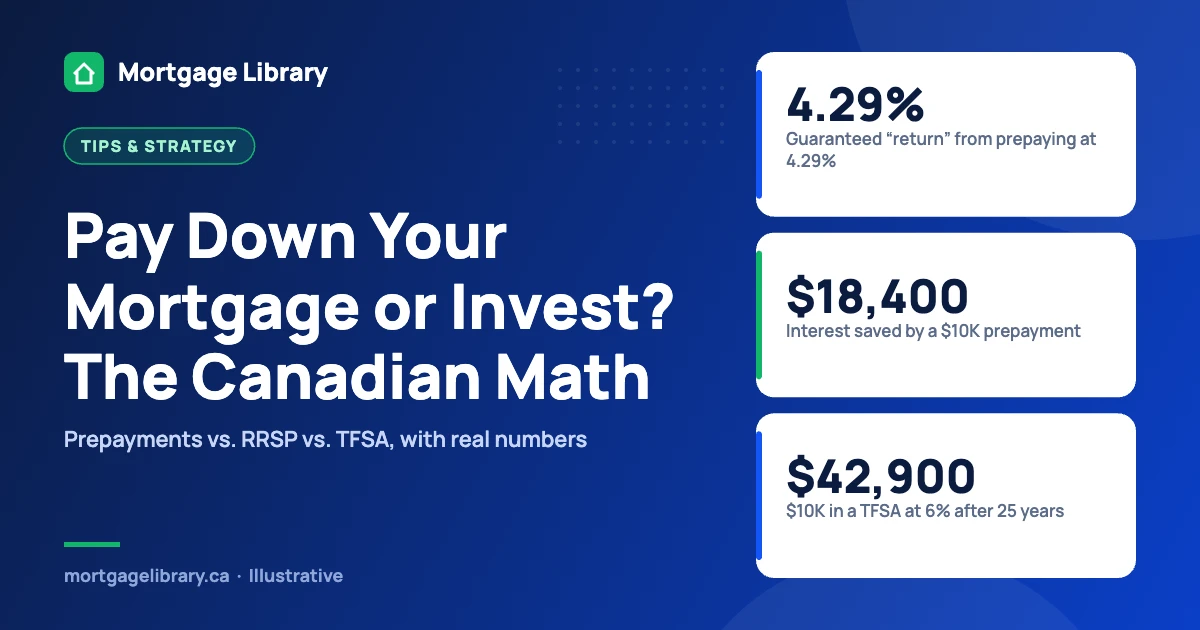
Every dollar you prepay saves you interest at your mortgage rate. So if your rate is 4.29%, prepaying is like earning a guaranteed 4.29% return, tax-free. In contrast, investing could earn more, or less, depending on markets. That is the core trade-off whenever you pay down a mortgage or invest.
Prepay vs. invest at a glance
Pay down the mortgage
- Guaranteed return equal to your rate
- Tax-free savings
- Lowers your payment or amortization
- Money is hard to get back out
Invest (TFSA or RRSP)
- Higher expected long-term returns
- Returns are not guaranteed
- RRSP gives a tax refund today
- Money stays accessible (especially a TFSA)
Example: a $10,000 lump sum
Imagine you have $10,000 and a $500,000 mortgage at 4.29% with 25 years left. Here is what each choice could look like:
What $10,000 could be worth after 25 years
In other words, investing only wins when your returns beat your mortgage rate after tax. At 6% a year, the TFSA pulls ahead. At 4%, however, prepaying wins, and it does so with no risk at all. So the choice to pay down your mortgage or invest comes down to the return you can realistically expect.
Is it better to buy RRSP or pay down a mortgage?
The RRSP adds a twist: a tax refund. For example, if you are in a 40% bracket, a $10,000 contribution could return about $4,000 at tax time. Then you can invest that refund, or use it to prepay your mortgage.
Therefore, the RRSP often beats prepaying when your tax bracket today is higher than you expect in retirement. Conversely, when your income is modest, the refund is smaller, so the guaranteed mortgage savings look better. You can learn more about how RRSPs work on the Canada Revenue Agency website.
When to pay down your mortgage first
Paying down your mortgage before you invest usually makes sense when:
- Your renewal is coming up. Prepaying before renewal lowers your balance, which softens renewal payment shock.
- You value certainty. A guaranteed return beats a risky one when stress about markets would keep you up at night.
- Your mortgage rate is high. When your rate is above 5%, prepaying becomes harder to beat.
- You are close to retirement. Being mortgage-free lowers the income you will need later.
When to invest first
On the other hand, invest before you pay down your mortgage when:
- Your employer matches RRSP contributions. A match is an instant return, so take it first.
- You have unused TFSA room. Money in a TFSA grows tax-free and stays accessible for emergencies.
- You are in a high tax bracket. The RRSP refund is worth more, so investing often wins.
- You have a long time horizon. Over decades, diversified investments have historically outpaced mortgage rates, although past returns never guarantee future ones.
How to pay down your mortgage efficiently
When you decide to prepay, do it the smart way. First, check your prepayment privileges, since most closed mortgages cap lump sums at 10% to 20% a year. Next, consider rounding up your payments or switching to accelerated bi-weekly. Finally, avoid going over your limit, because that could trigger a prepayment penalty.
Frequently asked questions
It depends on your mortgage rate, expected investment returns, tax bracket and risk tolerance. Prepaying earns a guaranteed return equal to your rate, while investing may earn more but is not guaranteed. Many people do both.
An RRSP often wins when your tax bracket is high, because the refund boosts your return. A popular strategy is to contribute to your RRSP and then use the refund to prepay your mortgage.
On a $500,000 mortgage at 4.29% over 25 years, an extra $100 a month pays it off about 18 months sooner and saves roughly $21,700 in interest.
Only if you have an emergency fund elsewhere. Because TFSA money stays accessible and grows tax-free, many people keep it invested and prepay from other savings instead.
Sources: FCAC: Paying off your mortgage faster · CRA: RRSPs and related plans · CRA: Tax-Free Savings Account