“How much mortgage can I afford?” is usually the first question Canadian buyers ask, and the answer is often lower than they expect. That is because lenders do not use the rate you will pay. Instead, they test you at a higher rate and cap how much of your income can go to housing and debt.
So this guide shows the rules lenders use in 2026, real examples for salaries from $60,000 to $150,000, and practical ways to qualify for more.
How lenders decide how much mortgage you can afford
First, lenders look at two debt service ratios. Both also use your gross (before-tax) income. For insured mortgages, CMHC sets the maximums, and most lenders also use similar limits for uninsured loans.
The two ratios that cap your mortgage
GDS: Gross Debt Service
- Mortgage payment
- Property taxes
- Heating costs
- 50% of condo fees
- Maximum: 39% of gross income
TDS: Total Debt Service
- Everything in GDS
- Car loans and leases
- Credit card and line of credit payments
- Student loans and other debts
- Maximum: 44% of gross income
Next, lenders calculate your payment at the stress-test rate, which is the higher of 5.25% or your contract rate plus 2%. So if you are offered 4.29%, you must qualify at 6.29%. As a result, the stress test is often the biggest factor in how much mortgage you can afford.
How much mortgage can I afford on my salary?
Because every budget differs, the table below assumes no other debts, $450 a month for property taxes and heating, and a qualifying rate of 6.29%. However, the 30-year column applies only to first-time buyers and buyers of newly built homes with an insured mortgage.
Approximate maximum mortgage by household income
| Gross household income | 25-year amortization | 30-year amortization |
|---|---|---|
| $60,000 | $228,000 | $245,000 |
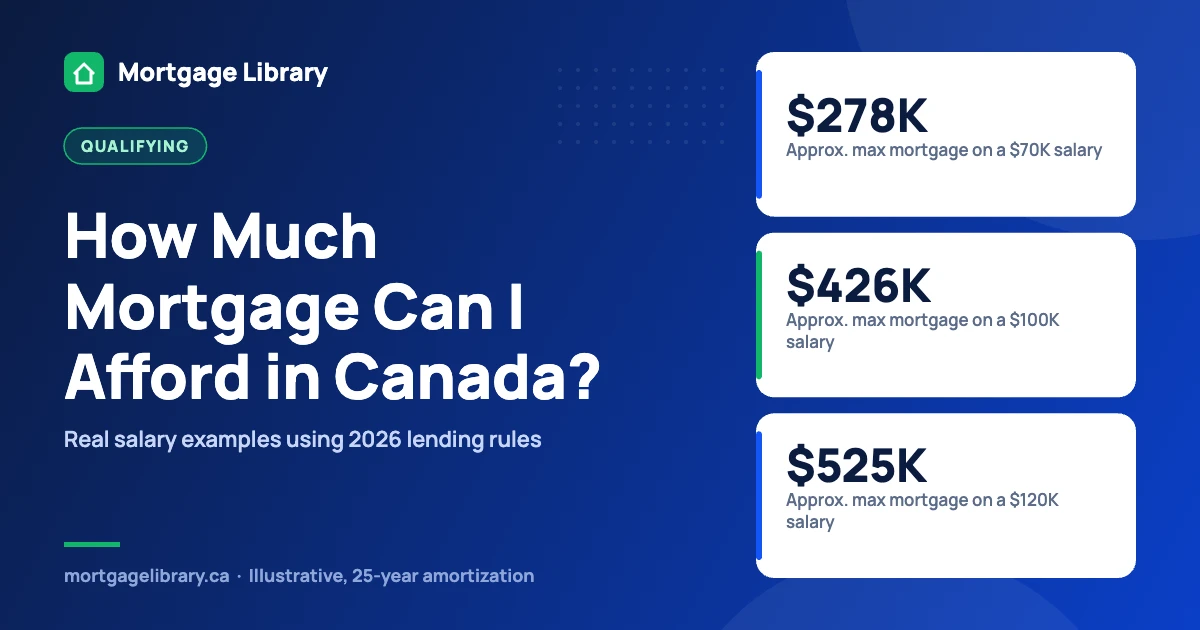
| $70,000 | $278,000 | $298,000 |
| $80,000 | $327,000 | $351,000 |
| $100,000 | $426,000 | $457,000 |
| $120,000 | $525,000 | $563,000 |
| $150,000 | $673,000 | $722,000 |
Maximum mortgage by salary (25-year amortization)
How other debts reduce what you can afford
Debts also eat into your TDS ratio. For instance, a $500 monthly car payment cuts the maximum mortgage on a $70,000 salary from about $278,000 to about $246,000. That is a $32,000 drop from a single loan, so small debts matter.
Effect of a $500/month car payment
From maximum mortgage to home price
Next, your home budget is your maximum mortgage plus your down payment, minus a cushion for closing costs. In Canada, you also need at least 5% down on the first $500,000 and 10% on the portion above that, as explained in our minimum down payment guide. With less than 20% down, you will also pay mortgage default insurance, which is added to your loan.
For example, a buyer earning $100,000 with $50,000 saved could target a home price of roughly $470,000. However, they would still want to keep about 1.5% to 4% of the price aside for closing costs.
5 ways to afford a bigger mortgage
- Pay down revolving debt first. Clearing credit card or line of credit balances lowers your TDS ratio right away, so your approval can rise.
- Add a co-borrower. When a spouse, partner or family member goes on title, their income also counts.
- Use a 30-year amortization. Also, first-time buyers and buyers of new builds can stretch to 30 years on an insured mortgage, which adds about 7% to your borrowing power.
- Document all your income. Bonuses, commissions and rental income can also count when you can prove them. Self-employed? See how lenders calculate self-employed income.
- Get pre-approved early. A pre-approval shows your real limit and also holds your rate.
What you qualify for vs. what you can afford
Still, a lender’s maximum is a ceiling, not a target. For example, it does not account for child care, savings goals or rising costs. So before you shop, build a monthly budget that includes the mortgage, taxes, insurance, utilities and maintenance. In fact, many buyers aim to keep total housing costs well below the 39% limit.
In addition, keep in mind that rates change at renewal. So if today’s payment already stretches your budget, a higher rate in five years could strain it further. Our mortgage rate forecast also explains what economists expect next.
Frequently asked questions
When you have no other debts and about $450 a month in property taxes and heating, a $70,000 salary supports a mortgage of roughly $278,000 over 25 years, based on qualifying at 6.29%. However, a 30-year amortization raises that to about $298,000.
Roughly $525,000 over 25 years with no other debts, or about $563,000 with a 30-year amortization when you qualify for one.
Lenders generally cap housing costs at 39% of gross income (the GDS ratio) and total debt payments at 44% (the TDS ratio). Both are also calculated at the stress-test rate.
Yes, because you must qualify at the higher of 5.25% or your contract rate plus 2%, so it usually reduces your maximum mortgage by 15% to 20% compared with qualifying at your actual rate.
Sources: CMHC: Qualifying for mortgage insurance · FCAC: Mortgage qualifying · OSFI Guideline B-20