Confused about an insured vs uninsured mortgage? You are not alone. It sounds complicated, but the idea behind it is simple enough for a seven-year-old to understand. In fact, it mostly comes down to one number: 20%.
So in this guide, we start with a simple story, then add pictures, real examples and the grown-up details. By the end, you will know exactly which type of mortgage you will get, and why it matters for your rate and your wallet.
Insured vs uninsured mortgage: the super-simple version
First, let’s start with a story. Imagine you want a $10 toy, but you only have $1. So you ask your mom to lend you the other $9.
Your mom loves you, but she is a little worried. After all, what if you never pay her back? Then your grandma steps in and says, “If you don’t pay Mom back, I will.” Grandma is like insurance. However, Grandma wants a small fee for her promise, and you are the one who pays it.
Now imagine you had saved $2 instead of $1. Because you brought more of your own money, your mom trusts you more. So she lends you the rest without needing Grandma at all. That is an uninsured loan.
The one number that decides everything: 20%
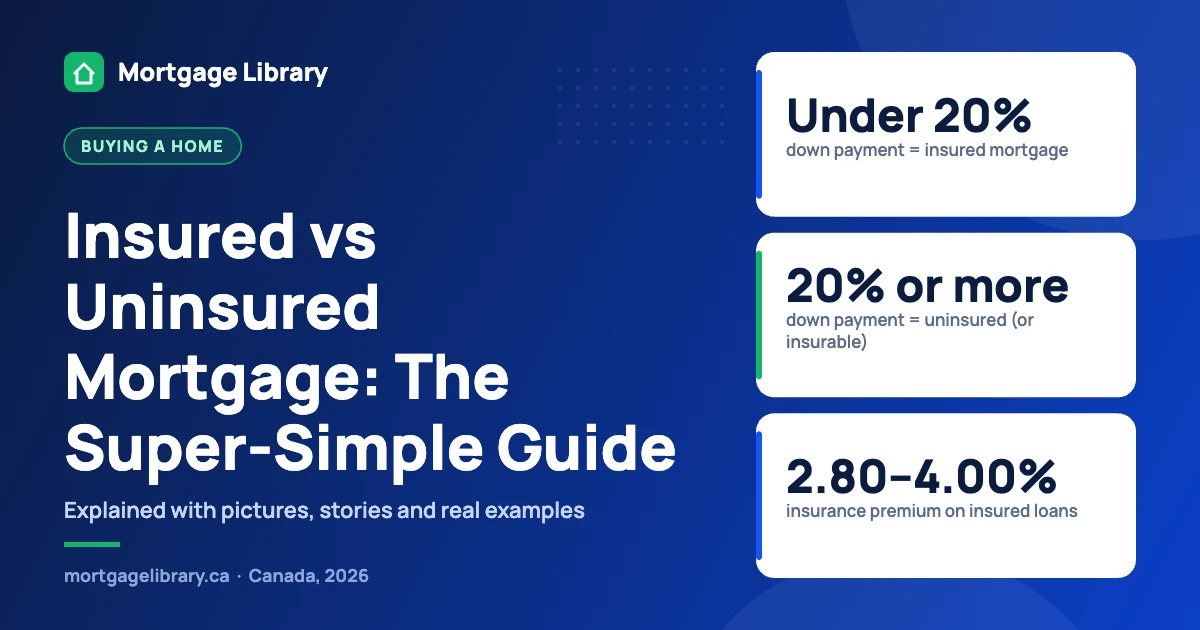
In Canada, the line between an insured vs uninsured mortgage is a 20% down payment. When your down payment is under 20% of the price, the law says your mortgage must be insured. In contrast, when you put down 20% or more, insurance is not required.
The 20% line: the one picture you need to remember
For example, Maya and Ben both have less than 20% down, so their mortgages are insured. Meanwhile, Sam and Priya both cross the line. Sam’s mortgage is “insurable”, while Priya’s is uninsured because her home costs more than $1 million. We explain that difference further below.
What is an insured mortgage?
An insured mortgage is a home loan backed by mortgage default insurance. It is sometimes called a “high-ratio” mortgage, because you borrow a high share of the home’s value. However, the insurance protects the bank, not you. Still, it is what allows you to buy a home with as little as 5% down.
Who does what in an insured mortgage?
Here are the main rules for an insured mortgage, according to CMHC and the Department of Finance:
- You put down at least the minimum down payment, but less than 20%.
- The home costs less than $1.5 million.
- The amortization is 25 years, or 30 years for first-time buyers and buyers of new builds.
- You (or a family member) will also live in the home.
- You pass the mortgage stress test.
How much does the insurance cost?
The premium is a one-time charge, and it is also usually added to your mortgage balance. So you pay it off slowly, along with your loan. Also, the smaller your down payment, the higher the premium, as shown on CMHC’s premium chart.
Insurance premium on a $500,000 home
What is an uninsured mortgage?
An uninsured mortgage has no default insurance at all. In other words, the bank takes on all the risk by itself. Because you put down at least 20%, the bank feels safe enough to lend without a safety net.
You also get an uninsured mortgage in some situations even when you have 20% down. For instance, these loans are always uninsured:
- A refinance, where you borrow against the equity in your home.
- A home that costs more than $1 million with 20% or more down.
- An amortization longer than the insurance rules allow, such as 30 years for a repeat buyer.
- A rental property that you will not live in.
The secret third type: insurable mortgages
Here is the part most beginners never hear about. Between insured and uninsured, there is a middle group called insurable. An insurable mortgage has 20% or more down, so you pay no premium. However, it still meets the insurance rules, so the bank can choose to insure it in the background at its own cost.
Why should you care? Because the bank can insure it cheaply, it often gives you a better rate than on a fully uninsured loan. Generally, a mortgage is insurable when the home is under $1 million, the amortization is 25 years or less, you will live there and you are buying or switching lenders, not refinancing, according to Ratehub.
Insured vs insurable vs uninsured at a glance
Insured
- Under 20% down
- You pay the premium
- Home under $1.5 million
- Usually the lowest rates
Insurable
- 20% or more down
- No premium for you
- Home under $1 million, 25 years max
- Rates close to insured
Uninsured
- 20% or more down
- No insurance at all
- Refinances, rentals, $1M+ homes
- Rates a little higher
Which one will I get? A quick flowchart
Not sure where you fit? Then simply follow the arrows below. First, start at the top, answer each question honestly, and you will land on your mortgage type.
Which mortgage will I get? Follow the arrows
Real examples: insured vs uninsured mortgage buyers
Next, let’s meet four buyers. Each one ends up with a different kind of mortgage, so you can see how the rules work in real life.
Four buyers, four outcomes
| Buyer | Home price | Down payment | Mortgage type | Monthly payment* |
|---|---|---|---|---|
| Maya, first-time buyer | $500,000 | 5% ($25,000) | Insured (premium $19,000 added) | ≈ $2,690 at 4.34% |
| Sam, moving up | $800,000 | 25% ($200,000) | Insurable | ≈ $3,301 at 4.44% |
| Priya, buying a big home | $1,200,000 | 40% ($480,000) | Uninsured (over $1 million) | ≈ $4,042 at 4.64% |
| Leo, refinancing for a renovation | $700,000 value | Borrowing more | Uninsured (refinance) | Depends on amount |
Notice something surprising? Maya put down the least money, yet she got the lowest rate. That is because her lender is protected by insurance. However, she also paid a $19,000 premium, so her total cost is not actually the lowest.
How rates compare for an insured vs uninsured mortgage
Lenders charge less when their risk is lower. As a result, insured mortgages usually get the best rates, insurable ones come next, and uninsured ones cost the most. Generally, the gap ranges from about 0.10% to 0.50%, depending on the lender and the market.
Monthly payment on the same $500,000 loan
Insured vs uninsured mortgage pros and cons
The trade-offs
Insured: pros and cons
- Pro: buy with as little as 5% down
- Pro: usually the lowest rates
- Con: you pay a premium of up to 4%
- Con: stricter limits on price and amortization
Uninsured: pros and cons
- Pro: no insurance premium
- Pro: more flexibility, including refinances and rentals
- Con: you need at least 20% down
- Con: rates are usually a little higher
So which is better? Honestly, though, neither is always better. Instead, it depends on how much you have saved, the price of the home and your plans. For example, waiting years to save 20% can cost more in rent than the premium would. On the other hand, when you already have 20%, skipping the premium saves thousands.
What happens to an insured mortgage at renewal?
Good news: once your mortgage is insured, it generally stays insured for its whole life. So at renewal, you can often keep getting insured-level rates, and you can even switch lenders without paying the premium again. However, if you refinance to borrow more, the new loan becomes uninsured.
Next, figure out how much mortgage you can afford, and then get a mortgage pre-approval so you know your options before you shop. Also, keep our mortgage glossary handy for any new words.
Frequently asked questions
An insured mortgage has default insurance because the buyer put down less than 20%, and the buyer pays the premium. An uninsured mortgage has 20% or more down and no insurance premium, although the rate is usually a little higher.
Neither is always better. Insured mortgages get lower rates but carry a premium of up to 4%, while uninsured mortgages avoid the premium but usually cost slightly more in interest. So the right choice depends on your savings and the home’s price.
An insurable mortgage has at least 20% down but still meets the insurance rules: a home under $1 million, a 25-year amortization or less, owner-occupied, and a purchase or switch rather than a refinance. The lender can insure it at its own cost, so the rate is often close to insured rates.
Yes, by putting down at least 20% of the purchase price. Savings, the FHSA, the RRSP Home Buyers’ Plan and gifts from family can also help you get there.
Because the insurer pays the lender if the borrower stops paying, insured mortgages are very low risk for lenders. As a result, lenders can offer their best rates on them.
Sources: CMHC: Qualifying for mortgage insurance · CMHC premium information · Department of Finance Canada · Ratehub: Insured, insurable and uninsured · FCAC: Choosing a mortgage