Canada has more first-time home buyer programs in 2026 than at any time in recent memory. Some help you save faster, while others cut your taxes or lower your monthly payment. However, they are spread across federal, provincial and city governments, so it is easy to miss one.
So we gathered every major first-time home buyer program in one place, with what each is worth, who qualifies and where to learn more.
Who counts as a first-time home buyer?
Most federal programs use the same test. Generally, you are a first-time buyer when you did not live in a home that you or your spouse owned in the current calendar year or the previous four years. So even if you owned a home years ago, you may qualify again.
Federal first-time home buyer programs
1. First Home Savings Account (FHSA)
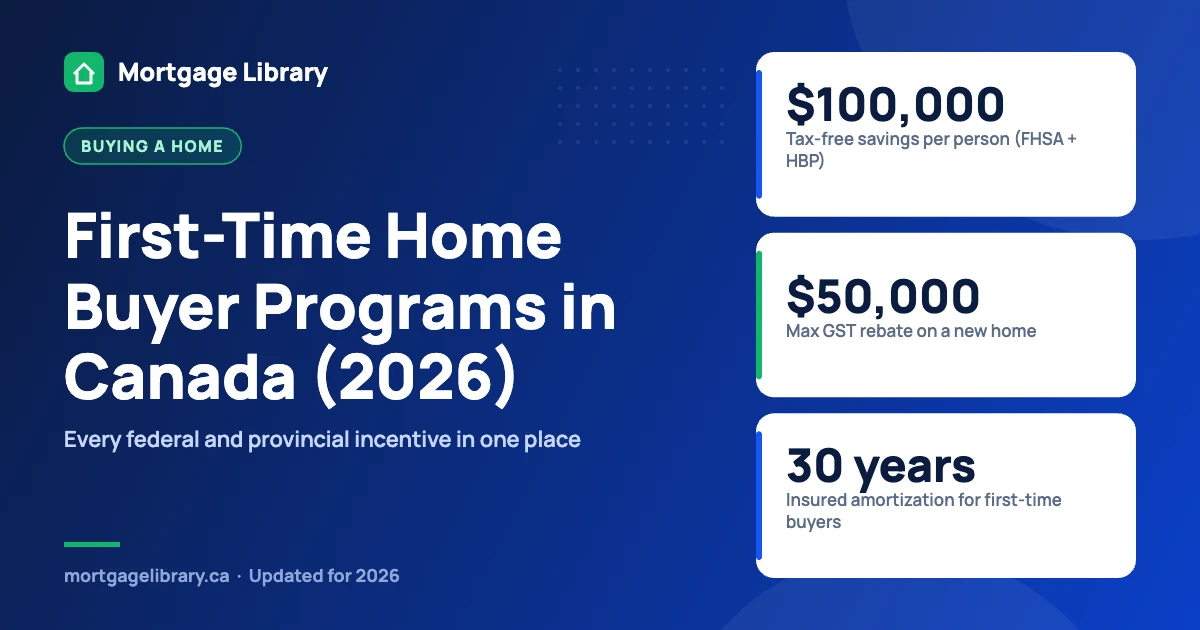
Overall, the FHSA is the best first-time home buyer program for most people. Contributions are tax-deductible, while qualifying withdrawals are tax-free. Also, if you never buy, you can move the money into your RRSP. For details, also read our full FHSA rules guide.
2. RRSP Home Buyers’ Plan
You can withdraw up to $60,000 from your RRSP without tax, while a couple can withdraw $120,000. However, you must repay it over 15 years. Right now, though, for first withdrawals made from 2026 to 2028, repayments do not start until the fifth year. Also see our Home Buyers’ Plan guide for details.
3. First-time buyer GST rebate
When you buy a newly built home, you can get back all of the GST, up to $50,000, on homes up to $1 million. The rebate then phases out by $1.5 million. You can also learn how to claim it in our GST rebate guide.
4. Home buyers’ amount (tax credit)
This non-refundable $10,000 tax credit reduces your federal tax by $1,500. You claim it on line 31270 of your tax return for the year you buy, and couples can also split it.
5. 30-year amortization and the $1.5 million cap
Since December 2024, first-time buyers can choose a 30-year amortization on an insured mortgage. As a result, monthly payments drop by roughly 9% compared with 25 years. In addition, the price cap for insured mortgages rose to $1.5 million, so buyers can put less than 20% down on more homes. However, keep in mind that CMHC insurance still applies.
Provincial and city first-time home buyer programs
In addition to the federal programs, several provinces and cities offer their own first-time home buyer programs. Here are the biggest:
Major provincial and municipal programs
| Where | Program | Maximum benefit |
|---|---|---|
| Ontario | Land transfer tax refund | Up to $4,000 |
| Toronto | Municipal land transfer tax rebate | Up to $4,475 |
| Ontario | First-time buyer HST rebate on new homes | Up to $80,000 (8% part) |
| British Columbia | Property transfer tax exemption | Tax-free on the first $500,000 (homes up to $835,000) |
For example, a first-time buyer in Toronto could save up to $8,475 in land transfer tax alone. Meanwhile, Ontario buyers of new homes can stack the provincial HST relief with the federal GST rebate. We also explain that in our Ontario HST rebate guide.
How to stack first-time home buyer programs
However, the real power comes from combining programs. For instance, a couple buying a new home could use:
Example: a couple stacking programs on a new $800,000 home
That could cover far more than the minimum down payment. In fact, it could help the couple reach 20% down and avoid mortgage insurance altogether.
Programs that have ended
Finally, be careful with older articles. The First-Time Home Buyer Incentive, a shared-equity mortgage from CMHC, stopped taking applications in 2024. So if a website still promotes it, the information is out of date.
Frequently asked questions
The main programs are the FHSA, the RRSP Home Buyers’ Plan, the first-time buyer GST rebate on new homes, the $10,000 home buyers’ tax credit and 30-year insured amortizations. Several provinces and cities also offer land transfer tax refunds.
For most federal programs, you qualify when you did not live in a home that you or your spouse owned in the current year or the previous four calendar years.
At least 5% on the first $500,000 of the price and 10% on the portion between $500,000 and $1.5 million. However, homes of $1.5 million or more need 20% down.
Yes, because most programs can be combined. For example, you can use the FHSA and the Home Buyers’ Plan for the same home, and also claim the home buyers’ tax credit.
Sources: CRA: Home buyers’ amount · Ontario land transfer tax refunds · City of Toronto MLTT rebates · BC first-time home buyers’ program