Mortgage broker vs bank: it is one of the first decisions you make when you buy, renew or refinance. A bank can only offer its own mortgages, while a broker can shop your file across many lenders. However, the better choice depends on your situation, not on a simple rule.
So this guide explains how each option works, how brokers get paid, who usually gets the better rate and when to use each.
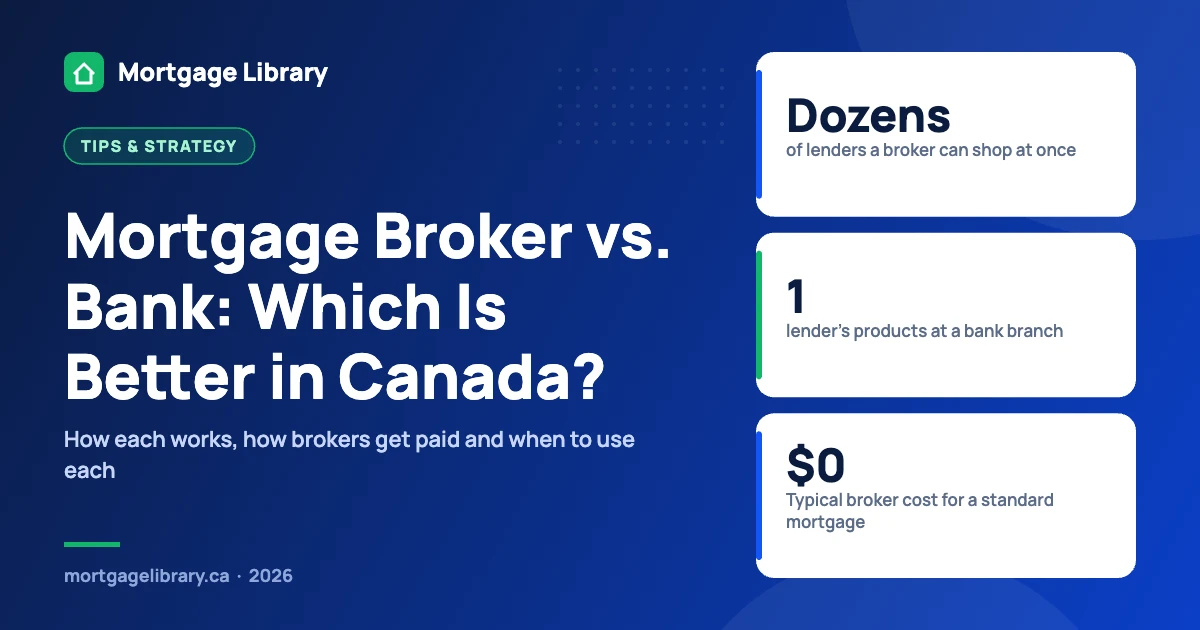
Mortgage broker vs bank: how each one works
When you go to a bank, you deal with a mortgage specialist who works for that bank. As a result, they can only offer that bank’s rates and products. In contrast, a mortgage broker is licensed by the province to arrange mortgages with many lenders. So a broker can compare big banks, credit unions, monoline lenders and, when needed, alternative lenders.
Mortgage broker vs bank at a glance
Mortgage broker
- Access to many lenders
- Usually free for standard mortgages
- Helpful for self-employed or unusual files
- One application, many options
Bank
- Only that bank’s products
- May offer relationship discounts
- Easy to bundle with a HELOC and accounts
- Familiar branch and app
How do mortgage brokers get paid?
For most standard mortgages, the lender pays the broker a finder’s fee when the mortgage closes. Typically, that fee is a fraction of a percent to about 1% of the loan, so it might be a few thousand dollars on a $500,000 mortgage. Because the lender pays it, you usually pay nothing directly.
However, brokers can charge fees for some files, such as private or alternative mortgages. In Ontario, the Financial Services Regulatory Authority also allows brokerages to charge an upfront fee on some larger loans. Therefore, always ask how and when your broker is paid, and get any fees in writing.
Can a mortgage broker do more than a bank?
In many cases, yes. Because a broker works with many lenders, they can match your file to the lender whose rules fit you best. That matters most when your situation is not simple. For example, brokers often help:
- Self-employed borrowers, since some lenders are more flexible about income, as our self-employed mortgage guide explains.
- Buyers with bruised credit, who may need an alternative lender for a short time.
- Investors with several properties, because lenders differ on how they treat rental income.
- Borrowers who want lower penalties, since some monoline lenders calculate the prepayment penalty more favourably.
On the other hand, a broker cannot always access every bank. For instance, some of the big banks only lend through their own staff, so a broker may not be able to offer those particular rates.
Mortgage broker vs bank: who gets the better rate?
There is no single answer. Still, brokers usually see discounted rates from many lenders at once, so they often find a lower rate than a bank’s first offer. Meanwhile, banks sometimes match or beat those rates, especially for existing clients with strong files.
That is why the smartest approach is to compare both. For example, get a quote from your bank, then ask a broker to beat it. Even 0.10% to 0.20% can save thousands over a term, as our 3-year vs. 5-year guide shows with real numbers.
When to choose a bank, and when to choose a broker
Mortgage broker vs bank: which fits your situation?
| Your situation | Usually a better fit |
|---|---|
| Simple purchase, strong credit, want bundled banking | Bank (or compare both) |
| Want the widest choice of rates | Broker |
| Self-employed or irregular income | Broker |
| Renewing and want a quick competing quote | Broker, then ask your bank to match |
| Want a HELOC combined with your mortgage | Bank (some brokers can offer this too) |
Finally, whichever route you choose, check that your adviser is licensed. In Ontario, you can verify a broker through the FSRA. Then compare offers carefully before you sign, and read our guides on pre-approval and switching lenders at renewal.
Frequently asked questions
It depends on your situation. A broker gives you access to many lenders and is usually free for standard mortgages, while a bank may offer relationship discounts and bundled products. Comparing both usually gets you the best deal.
Brokers are typically paid a finder’s fee by the lender, often a fraction of a percent up to about 1% of the loan. On a $500,000 mortgage, that could be a few thousand dollars, and it is usually not paid by you.
Often, yes, because a broker can shop many lenders, including credit unions, monolines and alternative lenders. However, some big banks do not lend through brokers.
Not usually for standard mortgages, because the lender pays them. However, they may charge fees for private or alternative mortgages, so always ask upfront.
Sources: FSRA: Mortgage brokering · FCAC: Choosing a mortgage · FCAC: Getting preapproved