A 30-year amortization can lower your mortgage payment by hundreds of dollars a month and help you qualify for a bigger loan. Since December 2024, it has also become available to far more Canadians. However, stretching your mortgage by five extra years comes at a price.
So this guide explains who qualifies for a 30-year amortization, what it really costs and when it is worth choosing.
What is a 30-year amortization?
Basically, your amortization is the total time it takes to pay off your mortgage. In contrast, your term, often five years, is simply how long your current rate lasts. So a 30-year amortization spreads your payments over 30 years instead of the traditional 25.
Who qualifies for a 30-year amortization in Canada?
Generally, it depends on your down payment. When you put down less than 20%, your mortgage must be insured, and stricter federal rules apply. Since December 15, 2024, the federal government has allowed 30-year amortizations on insured mortgages for:
- First-time home buyers, on any eligible home.
- Buyers of newly built homes, including repeat buyers.
Meanwhile, with 20% or more down, your mortgage is uninsured. In that case, most lenders already offer 30 years, and some even offer longer ones. However, uninsured rates can be slightly higher.
Who can stretch to 30 years?
Insured (under 20% down)
- First-time buyers: yes
- Buyers of new builds: yes
- Repeat buyers of resale homes: no
- 0.20% premium surcharge applies
Uninsured (20%+ down)
- Available at most lenders
- No insurance premium
- Longer options at some lenders
- Rates can be slightly higher
How much does a 30-year amortization lower your payment?
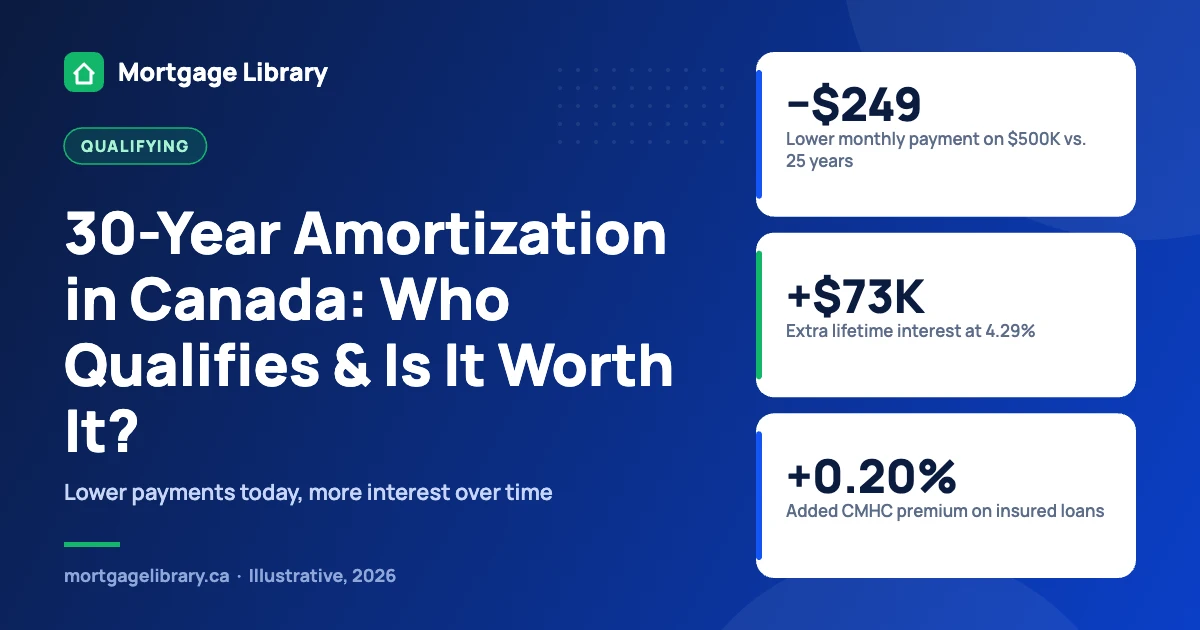
For example, on a $500,000 mortgage at 4.29%, stretching to 30 years cuts the monthly payment from about $2,709 to about $2,460. In other words, that is a saving of roughly $249 a month, or almost $3,000 a year.
Monthly payment on $500,000 at 4.29%
In addition, lenders qualify you using the longer amortization. As a result, the longer amortization raises your maximum mortgage by roughly 7%. Our affordability guide also shows the difference by salary.
What a 30-year amortization really costs
However, lower payments come with two costs. First, you pay interest for five extra years. Second, insured borrowers pay a higher CMHC insurance premium.
25 vs. 30 years on a $500,000 mortgage at 4.29%
| 25 years | 30 years | |
|---|---|---|
| Monthly payment | $2,709 | $2,460 |
| Total interest | ≈ $312,800 | ≈ $385,700 |
| Extra interest | — | ≈ $72,900 |
| CMHC premium with 5% down | 4.00% | 4.20% |
So the 30-year option costs about $73,000 more over the life of the loan. Still, that figure assumes you never prepay, and most borrowers do.
Is a 30-year amortization worth it?
It can be, especially when you use the flexibility wisely. The longer option often makes sense when:
- You need the lower payment to qualify, or to keep your budget comfortable.
- Your income is likely to rise, so you can prepay more later.
- You want a cushion for rate increases at renewal, which is a real risk right now, as our renewal payment shock guide explains.
On the other hand, it is less attractive when you can easily afford the 25-year payment. So in that case, the extra interest is money you do not need to spend.
How to cut 10 years off a 30-year mortgage
Therefore, the best strategy is to take the extra years for flexibility, then pay it down faster when you can. Here, then, is how:
- Pay the 25-year amount. Paying $2,709 instead of $2,460 on the example above clears the loan in about 25 years.
- Switch to accelerated bi-weekly. On its own, this cuts about four years off a 30-year schedule.
- Use your prepayment privileges. After all, lump sums go straight to principal. Read about prepayment privileges to see how much you can add each year.
- Round up every payment. Small, automatic increases also add up, as our round-up guide shows.
However, to cut a full 10 years, you would need to pay about $3,097 a month on the $500,000 example, which pays it off in 20 years. So in practice, most people combine several of these strategies over time.
Frequently asked questions
On insured mortgages, first-time home buyers and buyers of newly built homes qualify. With 20% or more down, most lenders also offer 30-year amortizations on uninsured mortgages.
On a $500,000 mortgage at 4.29%, it lowers the payment by about $249 a month compared with a 25-year amortization, although it adds roughly $73,000 in lifetime interest.
Yes. CMHC adds 0.20% to the premium, so a 4.00% premium becomes 4.20%.
Pay the 25-year payment amount, switch to accelerated bi-weekly payments, make lump-sum prepayments and round up your payments. Combined, these can then cut 5 to 10 years off your amortization.
Sources: Department of Finance Canada · CMHC premium information · FCAC: Paying off your mortgage faster