Should you choose a 3-year or 5-year mortgage? It is one of the most common questions at renewal, and in 2026 the answer is closer than usual. Right now, three-year fixed rates are slightly cheaper than five-year rates. However, a five-year term buys you two more years of certainty.
So this guide compares the two terms with real numbers, explains when each makes sense and shows the break-even rate that decides the winner.
3-year or 5-year mortgage: what’s the difference?
First, the term is how long your rate and conditions are locked in. In contrast, the amortization is how long it takes to pay off the whole loan. So when you pick a 3-year or 5-year mortgage, you are simply choosing when you will renegotiate next.
3-year vs. 5-year fixed
3-year fixed
- Slightly lower rate today
- Renew sooner, in 2029
- Smaller penalty if you break it early
- More exposure to future rate changes
5-year fixed
- Payment certainty until 2031
- Most popular term in Canada
- Larger IRD penalties if you break it
- Can lock in a higher rate for longer
How rates compare right now
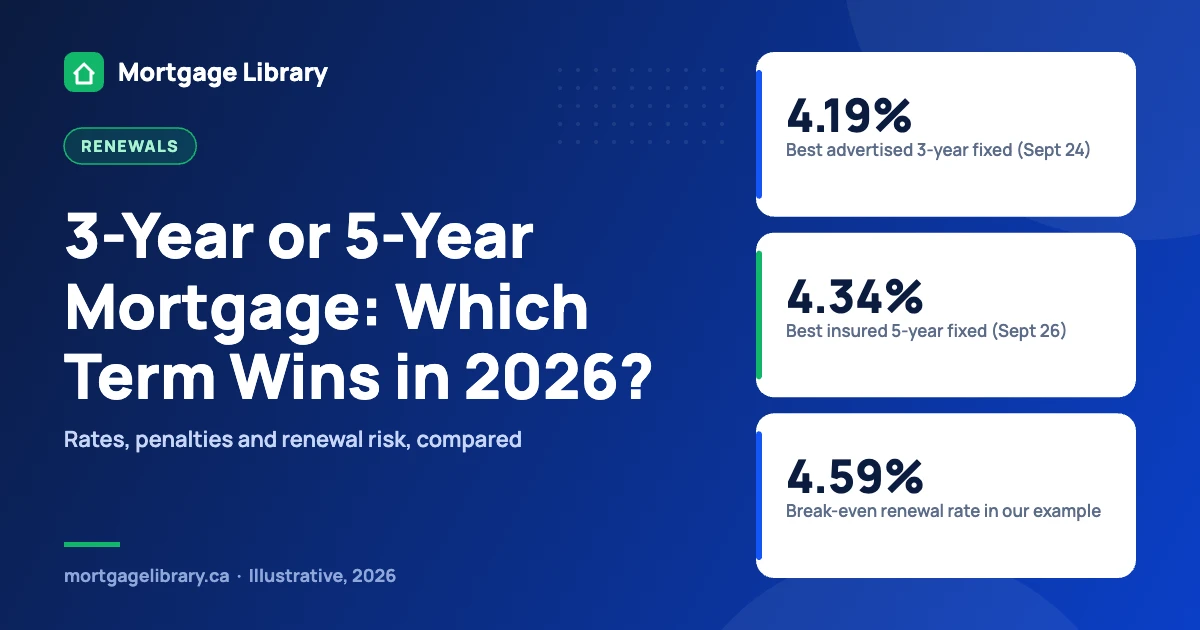
As of late September 2026, the best advertised 3-year fixed rate was 4.19%, according to Ratehub. Meanwhile, the best insured 5-year fixed rate was about 4.34%. Therefore, the shorter term is roughly 0.15% cheaper today.
For example, on a $500,000 mortgage with a 25-year amortization, that difference works out to about $41 a month. In addition, you would pay roughly $2,200 less interest over the first three years.
Monthly payment on $500,000 (25-year amortization)
The break-even rate for a 3-year or 5-year mortgage
However, the real question is what happens in year three. With the 3-year term, you then renew in 2029 for the final two years. So the shorter term only wins if that renewal rate is low enough.
Total interest over five years on $500,000
| Rate at 2029 renewal | 3-year, then renew | 5-year at 4.34% | Winner |
|---|---|---|---|
| 3.99% | $95,800 | $101,200 | 3-year |
| 4.34% | $99,000 | $101,200 | 3-year |
| 4.59% | $101,200 | $101,200 | Tie |
| 4.84% | $103,500 | $101,200 | 5-year |
| 5.34% | $108,000 | $101,200 | 5-year |
In other words, the 3-year option wins as long as 2029 rates stay below about 4.6%. Meanwhile, most forecasts expect only modest changes, as our mortgage rate forecast explains. Still, nobody can promise where rates will be three years from now.
When a 3-year mortgage makes sense
- You might move or refinance soon. Breaking a shorter term early usually costs less, because the penalty window is smaller.
- You expect rates to fall. A shorter term lets you renew sooner, so you benefit faster if rates drop.
- You plan big prepayments. Renewal is a penalty-free chance to pay down your balance, so a 3-year term gives you that chance sooner.
When a 5-year mortgage makes sense
- You want payment certainty. With a 5-year term, your payment stays the same until 2031.
- Your budget is tight. When a jump at renewal would hurt, locking in for longer reduces that risk.
- You think rates will rise. Several economists now see Bank of Canada hikes in 2027, although it is far from certain.
What about a 2-year or variable mortgage?
Some borrowers also ask whether to fix for 2 or 5 years. A 2-year term offers even more flexibility, but it also means renewing again in 2028. Alternatively, a variable rate also sits about 1% below 5-year fixed rates. So if you can handle payment changes, a variable mortgage may cost less than either fixed option. Our fixed vs. variable guide walks through that choice.
Finally, remember that you can shop around at renewal. When you switch lenders, you can pick the best term from any lender, not just your current one. For the full renewal process, also see our mortgage renewal guide.
Frequently asked questions
In 2026, a 3-year term is slightly cheaper than a 5-year term, so it wins if rates in 2029 stay below about 4.6%. However, a 5-year term offers more certainty and protects you if rates rise, so the right choice depends on your budget and plans.
The best 3-year fixed rate is about 0.15% lower than the best 5-year rate. Therefore, the 3-year term saves about $41 a month on a $500,000 mortgage, but it carries more renewal risk.
A 2-year term suits borrowers who expect rates to fall soon or who may move. In contrast, a 5-year term suits those who value payment certainty.
Usually, yes. Because fewer months remain on a shorter term, the interest rate differential penalty is often smaller than on a 5-year term.
Sources: Ratehub: 3-year fixed rates · Ratehub: 5-year fixed rates · FCAC: Renewing your mortgage