Closing costs in Canada catch many buyers off guard, because most of them must be paid in cash on closing day. Unlike your down payment, they cannot usually be added to your mortgage. In fact, lenders often want proof that you have them covered before they approve your loan.
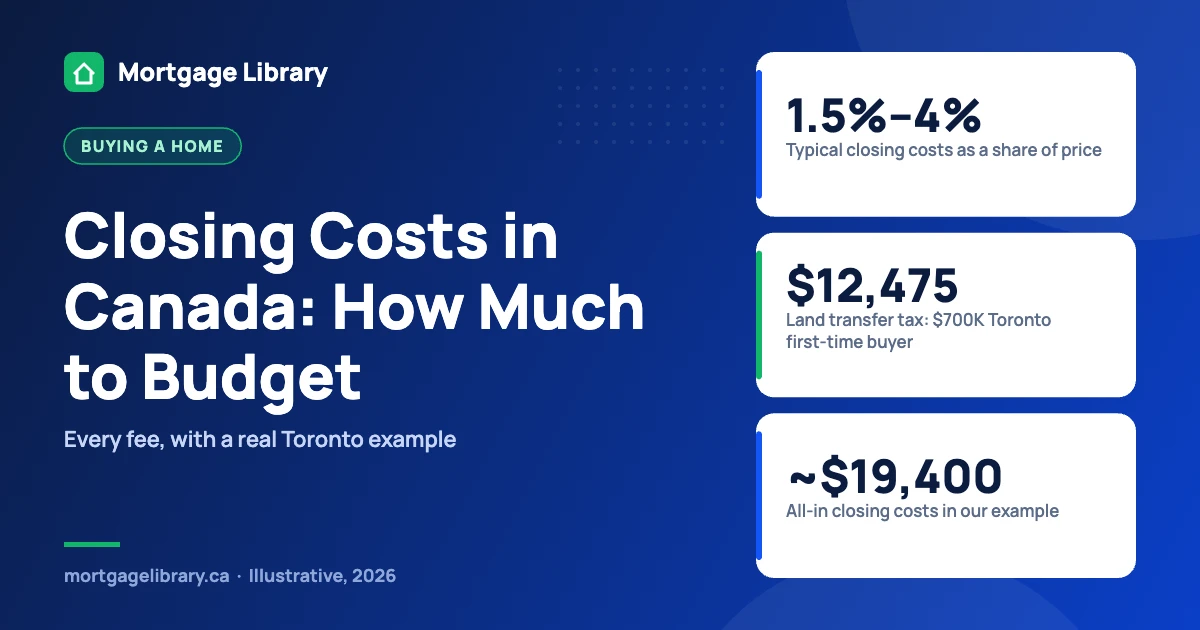
So how much should you budget? As a rule of thumb, then, plan for 1.5% to 4% of the purchase price. Below, we then break down every cost, show a real example and explain how to lower the bill.
What are closing costs?
Basically, closing costs are the taxes, fees and adjustments you pay to complete a purchase, on top of the down payment. First, some are fixed, such as legal fees. Others, however, depend on the price and your province, such as land transfer tax.
Every closing cost in Canada, explained
Typical closing costs in Canada
| Cost | Typical amount | When you pay |
|---|---|---|
| Land transfer tax | 0% to 3%+ of the price, by province | On closing |
| Legal fees and disbursements | $1,500 to $2,500 | On closing |
| Title insurance | $250 to $500 | On closing |
| Home inspection | $400 to $700 | Before firming up |
| Appraisal | $300 to $600 (often paid by the lender) | Before approval |
| Sales tax on mortgage insurance (ON, QC) | 8% or 9% of the premium | On closing |
| Property tax and utility adjustments | Varies | On closing |
| Moving costs | $500 to $3,000+ | Moving day |
Land transfer tax
Land transfer tax is usually the largest of the closing costs in Canada. For example, Ontario charges between 0.5% and 2.5% in brackets, and Toronto adds a municipal tax on top. In contrast, British Columbia charges a property transfer tax, while Alberta and Saskatchewan charge only modest land title fees.
Fortunately, however, first-time buyers get relief. For instance, Ontario refunds up to $4,000, as explained on the Ontario government website. Toronto also offers a rebate of up to $4,475. Meanwhile, B.C. exempts first-time buyers on the first $500,000 of homes up to $835,000.
Sales tax on mortgage insurance
When you put down less than 20%, your mortgage insurance premium is usually added to the loan. However, in Ontario and Quebec, the provincial sales tax on that premium cannot be financed, so you pay it at closing. Our CMHC insurance guide also shows how much it adds.
Adjustments and other surprises
If the seller prepaid property taxes or utilities, you then reimburse them for the days after closing. Also, for new builds, the statement of adjustments can include items such as development charges, utility connection fees and new home warranty enrolment. So always ask your builder for a list of possible adjustments before you sign.
Example: closing costs on a $700,000 Toronto home
For example, let’s look at a first-time buyer purchasing a $700,000 resale home in Toronto with 10% down.
Estimated closing costs, first-time buyer in Toronto
| Item | Amount |
|---|---|
| Ontario land transfer tax ($10,475 − $4,000 refund) | $6,475 |
| Toronto land transfer tax ($10,475 − $4,475 rebate) | $6,000 |
| Legal fees and disbursements | $2,000 |
| 8% PST on the CMHC premium | $1,562 |
| Adjustments (property tax, utilities) | $1,000 |
| Home inspection and title insurance | $850 |
| Moving | $1,500 |
| Total | ≈ $19,400 |
Land transfer tax on a $700,000 home
How to lower your closing costs in Canada
- Claim every first-time buyer refund. In Toronto, for instance, the two land transfer tax refunds alone can save up to $8,475.
- Compare lawyers’ flat fees. Many real estate lawyers offer all-in packages, so ask for quotes that include disbursements.
- Negotiate the closing date. A closing date right after a tax instalment can also reduce your adjustments.
- Ask about builder credits. For new builds, some builders also cap development charges or credit rebates at closing.
- Use tax-free savings. Your FHSA can also cover closing costs, not just your down payment.
How closing costs affect your mortgage approval
Lenders also usually require proof that you have at least 1.5% of the purchase price available for closing costs, on top of your down payment. So if your savings only cover the minimum down payment, your approval could stall. Therefore, build closing costs into your plan from day one, and review our list of first-time home buyer programs to reduce them.
Frequently asked questions
Closing costs in Canada typically range from 1.5% to 4% of the purchase price. The biggest variable, however, is land transfer tax, which is highest in Toronto and lowest in provinces such as Alberta and Saskatchewan.
Usually not. Instead, most closing costs must be paid in cash on closing day. The main exception is the mortgage insurance premium itself, although the sales tax on it must still be paid upfront in Ontario and Quebec.
Yes, but they get refunds in some provinces and cities. For example, Ontario refunds up to $4,000, Toronto rebates up to $4,475, and B.C. exempts the first $500,000 on eligible homes.
Lenders generally want to see at least 1.5% of the purchase price set aside for closing costs, in addition to your down payment.
Sources: Ontario land transfer tax refunds · City of Toronto MLTT rebates · BC first-time home buyers’ program · CMHC premium information