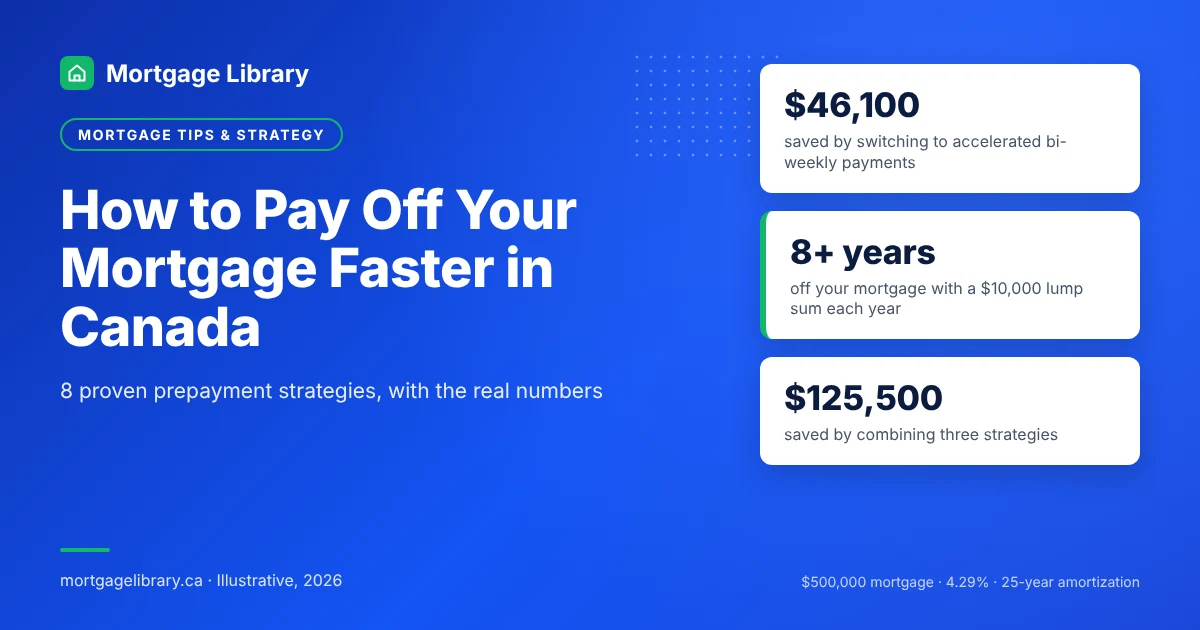
Most Canadians sign up for a 25-year mortgage and simply let it run. However, the way a mortgage is built means that even small extra payments can shave years off your loan and save you tens of thousands of dollars in interest. Best of all, most of these strategies are already built into your mortgage contract. You just have to use them.
In this guide, we walk through every major strategy for paying off your mortgage faster in Canada. For each one, we show you the real numbers, explain how it works, and point out the rules and traps to watch for.
Illustrative: $500,000 mortgage, 4.29% fixed rate held for the full amortization, compounded semi-annually as required for Canadian fixed-rate mortgages.
Our example mortgage
To keep things simple, every number in this guide uses the same example: a $500,000 mortgage at 4.29% with a 25-year amortization. With regular monthly payments, the payment is $2,709. Over the full 25 years, you would pay back the $500,000 plus about $312,788 in interest.
Of course, rates change at every renewal, so real life will look a little different. Still, the comparisons hold: the strategies that save the most here will save the most for you too. Want to plug in your own numbers? Try our mortgage calculator or learn how mortgage payments are calculated.
Why extra payments work so well
Mortgage payments are front-loaded with interest. In the first year of our example, about 65% of what you pay goes to interest ($21,039), and only $11,473 actually reduces your balance. As the balance shrinks, that mix slowly flips.
Where each year’s payments go
Here is the key point: every extra dollar you pay goes 100% to principal. That dollar then stops charging interest for the rest of your mortgage. So a prepayment is really a guaranteed, tax-free return equal to your mortgage rate. And because interest is calculated on the balance, the earlier you prepay, the bigger the effect.
Strategy 1: Switch to accelerated bi-weekly or weekly payments
This is the easiest win in Canadian mortgages. With accelerated bi-weekly payments, you take your monthly payment, cut it in half, and pay that amount every two weeks. Since there are 52 weeks in a year, you make 26 half-payments. That works out to 13 full monthly payments a year instead of 12.
That one extra payment a year goes straight to principal. As a result, it quietly knocks years off your mortgage, and you barely notice it in your budget.
Payment frequency compared
| Frequency | Payment | Time to pay off | Total interest | Interest saved |
|---|---|---|---|---|
| Monthly | $2,709.29 | 25 yrs | $312,788 | — |
| Bi-weekly (regular) | $1,250.44 | 25 yrs | $311,411 | $1,377 |
| Accelerated bi-weekly | $1,354.65 | 21 yrs 9 mo | $266,700 | $46,088 |
| Accelerated weekly | $677.32 | 21 yrs 9 mo | $266,185 | $46,603 |
Also, timing matters. If you are paid every two weeks, matching your mortgage payment to payday makes the switch feel painless. Most lenders let you change your payment frequency for free at any time, so it is worth a quick call.
Strategy 2: Increase your regular payment
Most closed mortgages include a payment increase privilege. It lets you raise your regular payment by a set percentage each year without penalty. Depending on the lender, the limit is commonly 10%, 15%, 20% or even 100% of your original payment.
The higher payment then becomes your new normal. Because every extra dollar hits principal, the savings add up fast.
Interest saved by increasing your monthly payment
A good habit: every time you get a raise, bump up your mortgage payment by part of it. You never get used to the extra money, so you never miss it.
Strategy 3: Make annual lump-sum prepayments
Closed mortgages also come with a lump-sum prepayment privilege. It lets you pay down a chunk of your principal each year, commonly 10% to 20% of the original mortgage amount. On a $500,000 mortgage, a 15% privilege means you could prepay up to $75,000 a year, penalty-free.
You do not need anywhere near that much to make a difference. Here is what a yearly lump sum does in our example:
Yearly lump-sum prepayments
| Lump sum each year | Time to pay off | Total interest | Interest saved | Time saved |
|---|---|---|---|---|
| None | 25 yrs | $312,788 | — | — |
| $5,000 | 19 yrs 11 mo | $242,248 | $70,540 | 5 yrs 1 mo |
| $10,000 | 16 yrs 7 mo | $199,005 | $113,783 | 8 yrs 5 mo |
The earlier, the better
Timing makes a huge difference. A single $10,000 prepayment in year one saves far more than the same $10,000 later on, because it has more years to stop interest from piling up.
What one $10,000 prepayment saves, by year
Good sources for lump sums include tax refunds, work bonuses, a TFSA or savings account you have built up, an inheritance, or money from selling something you no longer need. Some lenders let you prepay several times a year, but others only allow one lump sum per year, or have a minimum (often $100 or more). So check your mortgage terms before you send money. Our guide to mortgage prepayment privileges explains how these limits work in detail.
Strategy 4: Round up your payment
If a big jump in your payment feels like too much, start small. Rounding a $2,709 payment up to $2,800 or $3,000 is easy to budget for and still powerful. In our example, just $100 more a month saves about $21,700 and 1 year, 6 months.
Rounding up uses your payment increase privilege, so the same limits apply. For more examples, see our guide on rounding up your mortgage payments.
Strategy 5: Use double-up payments
Many lenders offer a double-up feature. It lets you make an extra payment equal to your regular payment on any payment date. For example, if you get a bonus in March, you could double your March payment, and every cent of the second payment goes to principal.
Double-ups are flexible because you choose when to use them. However, they usually count toward your annual payment increase or lump-sum limit, so track how much you have used each year.
Strategy 6: Keep the same payment at renewal
Renewal is one of the most overlooked chances to pay off your mortgage faster. Every few years, your term ends and you renew. At that point, two things can quietly slow you down, or speed you up.
Do not reset the clock
Some borrowers re-amortize back to 25 years at renewal to lower their payment. That can be useful in a tight month, but it is expensive. In our example, after five years you would owe about $437,400. Stretching that back to 25 years instead of the remaining 20 at the same rate would add roughly $60,900 in extra interest.
If rates drop, keep your old payment
If you renew at a lower rate, your lender will usually offer you a lower payment. Instead, ask to keep your payment the same. For example, if you renew that $437,400 balance at 3.79% instead of 4.29%, keeping your $2,709 payment rather than dropping to about $2,596 pays the mortgage off about 14 months sooner and saves roughly $12,400 more in interest.
Renewal is also when you can usually prepay any amount without a penalty, because your term has ended. So if you have savings set aside, that is the perfect moment to put them toward the balance. For a full walk-through, see our mortgage renewal guide and how to switch lenders at renewal.
Strategy 7: Choose a shorter amortization from the start
The most direct way to save interest is to borrow over a shorter period. A 20-year amortization has higher payments than a 25-year one, but much lower total interest. On the other hand, a 30-year amortization lowers your payment but adds a lot of interest over time.
A smart middle ground is to take the longer amortization for flexibility, then pay it as if it were shorter using the prepayment strategies above. That way, if money gets tight, you can drop back to the regular payment. Read more in our guide on 30-year amortizations in Canada.
Strategy 8: Stack the strategies together
The real magic happens when you combine strategies. Here is what happens if you switch to accelerated bi-weekly payments, raise them by 10%, and add a $5,000 lump sum every year:
Mortgage balance over time
Every strategy at a glance
Ranked by interest saved
| Strategy | Extra cost | Interest saved | Time saved |
|---|---|---|---|
| Regular bi-weekly payments | Free | $1,377 | Under 1 month |
| Round up by $100 a month | +$100/mo | $21,703 | 1 yr 6 mo |
| Accelerated bi-weekly payments | +$226/mo equivalent | $46,088 | 3 yrs 3 mo |
| Accelerated weekly payments | +$226/mo equivalent | $46,603 | 3 yrs 3 mo |
| Increase payment by 10% | +$271/mo | $52,292 | 3 yrs 8 mo |
| $5,000 lump sum every year | $5,000/yr | $70,540 | 5 yrs 1 mo |
| Increase payment by 20% | +$542/mo | $89,100 | 6 yrs 5 mo |
| Accelerated bi-weekly + $5,000/yr | +$226/mo + $5,000/yr | $98,505 | 7 yrs 1 mo |
| $10,000 lump sum every year | $10,000/yr | $113,783 | 8 yrs 5 mo |
| Accelerated bi-weekly +10% + $5,000/yr | +$519/mo + $5,000/yr | $125,526 | 9 yrs 2 mo |
Know your prepayment privileges (and limits)
Every strategy above depends on your mortgage’s prepayment privileges. These are the rules in your contract for how much extra you can pay each year without a penalty. They vary a lot from lender to lender, so it pays to know yours.
Typical prepayment privileges in Canada
| Feature | Common range | What to check |
|---|---|---|
| Lump-sum prepayment | 10% to 20% of the original amount per year | Is it based on the original or current balance? Is there a minimum? How many times a year? |
| Payment increase | 10% to 100% of your original payment | Can you lower it again later? Does it reset each year? |
| Double-up payments | Up to 1 extra payment per payment date | Does it count toward your annual limit? |
| Unused privileges | Usually lost at year end | Very few lenders let you carry unused room forward. |
| Open mortgage | Prepay any amount, any time | Rates are usually much higher than closed mortgages. |
The Financial Consumer Agency of Canada also has a helpful overview of ways to pay off your mortgage faster. If you are shopping for a new mortgage and plan to prepay aggressively, compare prepayment privileges as carefully as you compare rates. A slightly lower rate with weak privileges can cost you more in the long run. A mortgage broker can help you compare these features across lenders.
Avoid prepayment penalties
If you pay more than your privileges allow on a closed mortgage, you will usually be charged a prepayment penalty on the extra amount. The same goes for breaking your mortgage early to refinance or switch lenders.
- Variable-rate mortgages: usually three months of interest.
- Fixed-rate mortgages: usually the greater of three months of interest or the interest rate differential (IRD). The IRD can be much larger, especially with the big banks.
For a sense of scale: three months of interest on about $476,600 at 4.29% is roughly $5,100. An IRD penalty can be several times higher. So always stay within your annual limits, and ask your lender for a written penalty quote before you pay more. The FCAC explains how prepayment penalties work and how to reduce them, and our guide to mortgage prepayment penalties walks through the math.
When paying off your mortgage faster is not the best move
Prepaying your mortgage is a guaranteed, risk-free return. But it is not always the best first step. Before you send extra money to your lender, make sure you have:
- Paid off high-interest debt. A credit card at 20% costs far more than a mortgage at 4%.
- Built an emergency fund. Money you prepay is hard to get back out unless you have a HELOC or refinance.
- Taken any free money. If your employer matches RRSP contributions, take the full match first.
- Compared investing. If your mortgage rate is low, investing in a TFSA or RRSP may come out ahead over time.
Not sure which way to go? Our guide on whether to pay down your mortgage or invest compares both with real Canadian numbers.
Your step-by-step action plan
How to start shaving time off your mortgage
Find your prepayment privileges
Check your mortgage contract, annual statement or online banking for your lump-sum and payment increase limits.
Switch to accelerated payments
Call your lender and move to accelerated bi-weekly or weekly payments, ideally timed with payday.
Round up or increase your payment
Start with $50 to $100 more a month, then increase it with every raise.
Plan an annual lump sum
Send tax refunds and bonuses to your mortgage, and do it early in your privilege year.
Protect your progress at renewal
Keep your amortization shrinking, keep your payment the same if rates fall, and prepay penalty-free when your term ends.
The bottom line
You do not need a windfall to pay off your mortgage faster. Switching to accelerated bi-weekly payments alone can save around $46,100 on a $500,000 mortgage. Add a modest payment increase and a yearly lump sum, and you could be mortgage-free close to a decade early.
Start with one strategy this month, stay inside your prepayment limits, and revisit your plan every renewal. Your future self will thank you.
Frequently asked questions
Accelerated bi-weekly payments are better if you want to pay off your mortgage faster. They add the equivalent of one extra monthly payment a year. On a $500,000 mortgage at 4.29%, that saves about $46,100 and 3 years, 3 months. Regular (non-accelerated) bi-weekly payments save very little.
It depends on your lender. Closed mortgages commonly allow a lump-sum prepayment of 10% to 20% of the original mortgage amount each year, plus a payment increase of 10% to 100%. Open mortgages let you prepay any amount at any time. Check your mortgage contract or annual statement for your exact limits.
Both work, because every extra dollar goes to principal. The best choice is the one you can stick with. A higher regular payment builds the habit automatically, while lump sums work well for irregular money like bonuses and tax refunds. In general, the sooner the money goes in, the more interest it saves.
Yes. Prepayments made under your prepayment privileges go directly toward your principal balance, which lowers the interest charged from then on. Your regular payment usually stays the same, so the mortgage is paid off sooner.
Yes. You can pay off your mortgage early at any time, but on a closed mortgage you may pay a prepayment penalty on any amount above your annual privileges. You can pay off any amount without a penalty at the end of your term, when your mortgage comes up for renewal.
Prepaying gives you a guaranteed, tax-free return equal to your mortgage rate. Investing in a TFSA or RRSP may earn more over time, but returns are not guaranteed. Many Canadians do both. First, pay off high-interest debt and build an emergency fund.
This guide is for general education only and is not financial advice. Examples are illustrative and assume a constant 4.29% rate for the full amortization; your rate, lender rules and results will differ. Always confirm your prepayment privileges and any penalties with your lender.