The 50-year mortgage became one of the most searched housing ideas of the past year. It first started in the United States, where it was floated as a way to make homes more affordable. So naturally, many Canadians asked whether one is available here, and whether it would help.
The short answer, though, is no: Canada does not offer mainstream 50-year mortgages. However, understanding why, and what it would cost, helps you choose the right amortization for your own mortgage.
Where did the 50-year mortgage idea come from?
In late 2025, U.S. housing officials floated the idea of 50-year loans to lower monthly payments. However, the proposal drew heavy criticism from economists and industry groups. Then, by January 2026, the head of the U.S. Federal Housing Finance Agency said the administration had other priorities, according to The MortgagePoint. In other words, the plan was effectively shelved.
Is there a 50-year mortgage in Canada?
No. In Canada, the rules instead depend on whether your mortgage is insured. When you put down less than 20%, the maximum amortization is 25 years, or 30 years for first-time buyers and buyers of new builds. Meanwhile, with 20% or more down, most lenders offer up to 30 years, and a few offer 35.
Longest amortizations available in Canada
| Situation | Maximum amortization |
|---|---|
| Insured, repeat buyer of a resale home | 25 years |
| Insured, first-time buyer or new build | 30 years |
| Uninsured (20%+ down), most lenders | 30 years |
| Uninsured, some lenders | 35 years |
| 50 years | Not offered by mainstream lenders |
What would a 50-year mortgage actually cost?
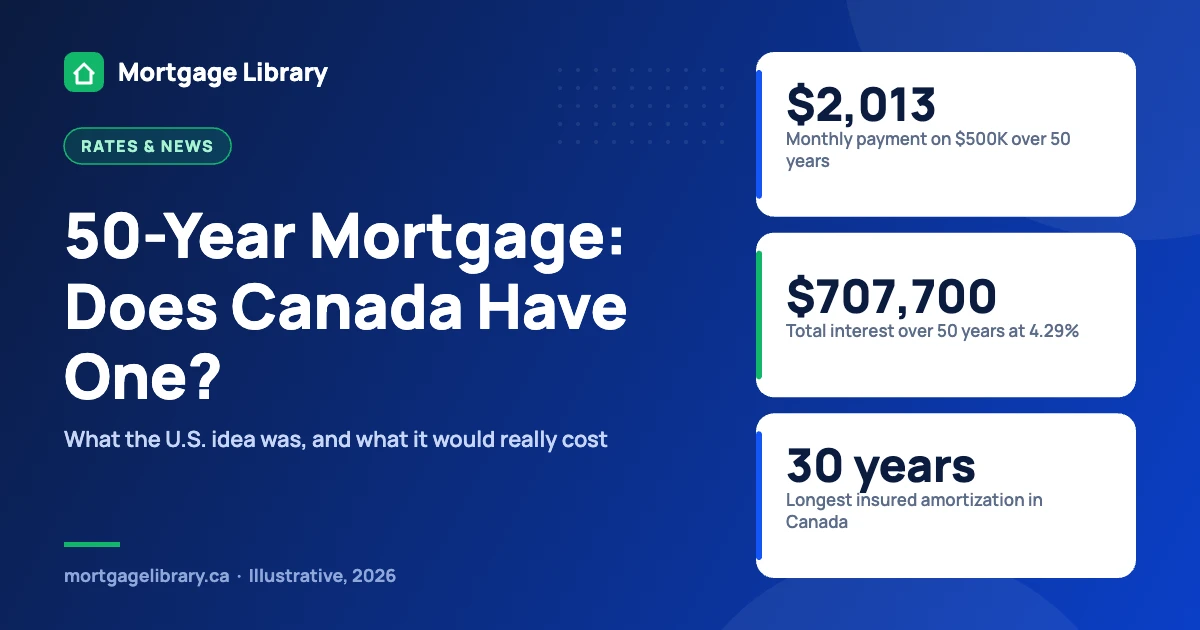
A longer amortization lowers the payment, but the savings shrink quickly while the interest balloons. For example, here is a $500,000 mortgage at 4.29%:
$500,000 at 4.29%: 25 vs. 30 vs. 40 vs. 50 years
| Amortization | Monthly payment | Total interest | Principal paid in 5 years |
|---|---|---|---|
| 25 years | $2,709 | $312,800 | $62,600 |
| 30 years | $2,460 | $385,700 | $45,900 |
| 40 years | $2,169 | $541,000 | $26,500 |
| 50 years | $2,013 | $707,700 | $16,100 |
Total interest paid on $500,000 at 4.29%
So a 50-year mortgage would lower the payment by about $700 a month compared with 25 years. Yet it would add almost $400,000 of interest. In addition, you would build equity very slowly, repaying only about $16,000 of principal in the first five years. In other words, each extra decade adds far more interest than it saves in payments.
Why a 50-year mortgage may not improve affordability
Lower payments certainly sound appealing. However, economists point to several problems, especially in a market like Canada’s.
- Prices could rise. When buyers can borrow more, they often bid up prices, which cancels out the benefit.
- Equity builds slowly. So if prices dip, borrowers could owe more than the home is worth.
- Renewal risk grows. In Canada, you renew every few years, so a larger balance means bigger swings at each renewal.
- Retirement debt. For example, a 35-year-old buyer would still be paying at 85.
Better ways to lower your payment
When you need a lower payment, Canada already offers more practical tools. First, a 30-year amortization lowers payments by about 9% compared with 25 years. Next, a larger down payment, supported by the FHSA and the Home Buyers’ Plan, reduces the loan itself.
Also, consider the rate side of the equation. For instance, comparing lenders or choosing a different term can save as much as stretching the amortization. Our broker vs. bank guide also explains how to shop. Finally, check how much mortgage you can afford before you set a budget.
Frequently asked questions
No. Mainstream Canadian lenders do not offer 50-year mortgages. Insured mortgages are limited to 25 years, or 30 years for first-time buyers and new builds, while some uninsured mortgages go to 35 years.
It was floated in late 2025, but in January 2026 the head of the Federal Housing Finance Agency said the administration had other priorities, so the idea was effectively shelved.
On a $500,000 mortgage at 4.29%, a 50-year amortization would lower the payment from about $2,709 to about $2,013. However, it would increase total interest from about $312,800 to about $707,700.
For insured mortgages, it is 30 years for first-time buyers and buyers of new builds. For uninsured mortgages, however, some lenders offer up to 35 years.
Sources: The MortgagePoint (Jan 2026) · Department of Finance Canada · CMHC premium information