The income needed for a mortgage in Canada depends on three things: the size of the loan, the stress-test rate and your other debts. Because lenders qualify you at a higher rate than you will actually pay, the salary required is often higher than buyers expect.
So in this guide, we work backwards. First, we show the income needed for mortgages from $400,000 to $1 million. Then we translate that into home prices, and finally we cover four ways to qualify with less.
How lenders work out the income needed for a mortgage
Lenders use two ratios. First, your housing costs, including the mortgage payment, property taxes and heating, cannot exceed about 39% of your gross income. Second, all your debt payments together cannot exceed about 44%. These limits come from CMHC, and most lenders also use similar rules.
In addition, the payment is calculated at the stress-test rate, not your actual rate. So with typical five-year fixed rates near 4.3% today, that means qualifying at about 6.3%. As a result, the stress test is the main reason the income needed for a mortgage feels so high.
Income needed for a mortgage, by loan size
Because everyone’s debts differ, the table below assumes no car loans or other debts, plus $450 a month for property taxes and heating. It also assumes you qualify at 6.29%.
Approximate household income needed
| Mortgage amount | 25-year amortization | 30-year amortization |
|---|---|---|
| $400,000 | $95,000 | $89,000 |
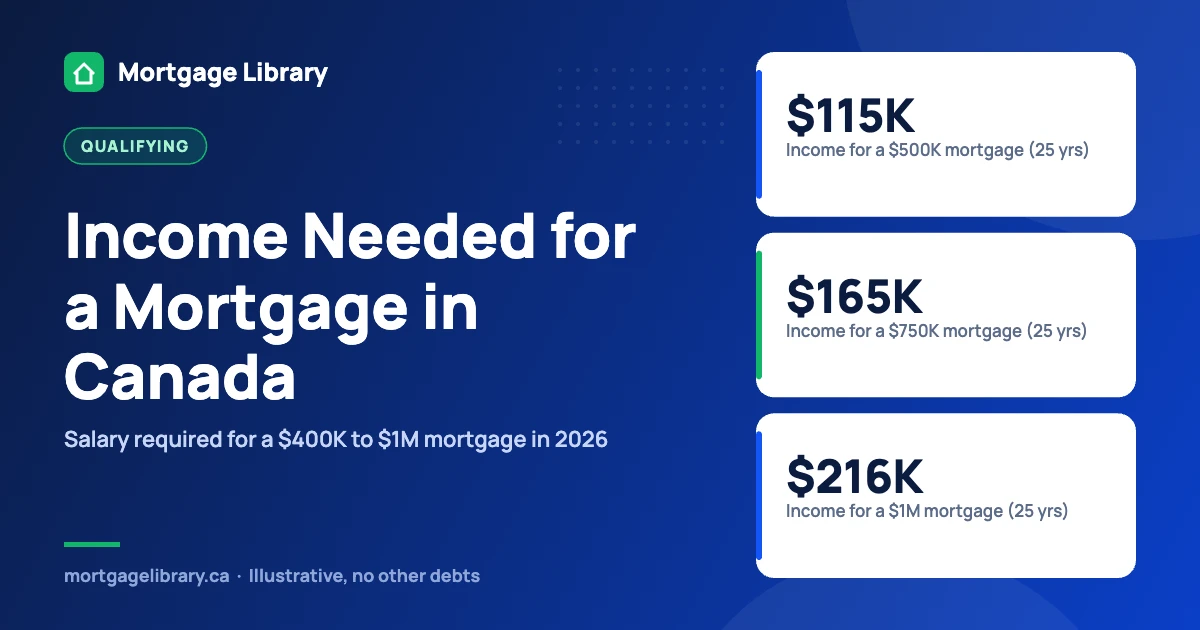
| $500,000 | $115,000 | $108,000 |
| $600,000 | $135,000 | $127,000 |
| $750,000 | $165,000 | $155,000 |
| $1,000,000 | $216,000 | $202,000 |
Income needed by mortgage size (25-year amortization)
What income do you need for a $1,000,000 mortgage?
This is one of the most searched questions in Canada, especially in Toronto and Vancouver. When you have no other debts, you would need about $216,000 of household income over 25 years, or about $202,000 over 30 years. So for most buyers, a $1 million mortgage takes two strong incomes.
Also keep in mind that the monthly payment at today’s rates would be roughly $5,400. At the stress-test rate, however, the lender tests you at about $6,600 a month, and that is the number your income must support.
Salary needed by home price (with minimum down payment)
Buyers often think in home prices rather than mortgage amounts. So here is the income needed when you put down the minimum down payment. Because these buyers have less than 20% down, the table also includes the mortgage insurance premium added to the loan.
Approximate income needed by home price
| Home price | Minimum down | 25-year | 30-year (first-time/new build) |
|---|---|---|---|
| $400,000 | $20,000 | $94,000 | $88,000 |
| $500,000 | $25,000 | $114,000 | $107,000 |
| $600,000 | $35,000 | $133,000 | $125,000 |
| $750,000 | $50,000 | $161,000 | $151,000 |
| $1,000,000 | $75,000 | $208,000 | $195,000 |
Interestingly, however, the income needed for a $500,000 house is about $114,000 with 5% down. That is slightly less than for a $500,000 mortgage, since the down payment shrinks the loan.
4 ways to lower the income needed for a mortgage
- Pay off debts first. Each $100 of monthly debt payments you clear then adds roughly $10,000 to $15,000 of borrowing power.
- Add a co-borrower. In fact, combining incomes is the most common way couples reach a larger mortgage.
- Choose a longer amortization. When you qualify for 30 years, the income needed drops by about 6% to 7%.
- Save a larger down payment. Every extra dollar down reduces the loan, so you need less income. Tax-free accounts such as the FHSA can also help you get there faster.
Other factors lenders consider
However, income is only one part of the approval. Lenders also look at your credit score, job stability and the property itself. For example, self-employed borrowers usually need two years of tax returns, as explained in our self-employed mortgage guide.
Meanwhile, federally regulated lenders face OSFI loan-to-income limits on the share of uninsured mortgages above 4.5 times income. However, that does not cap any single borrower. Still, it can make lenders more cautious with very large loans.
Finally, to turn these numbers into a home budget, read how much mortgage you can afford. Then learn how to calculate mortgage payments so you can check any quote.
Frequently asked questions
With no other debts, you need roughly $115,000 of household income over a 25-year amortization, or about $108,000 over 30 years, because lenders qualify you at the stress-test rate of about 6.29%.
About $216,000 of household income over 25 years, or roughly $202,000 over 30 years, when you have no other debts.
With the minimum 5% down payment and no other debts, you would need about $114,000 of household income over 25 years, or about $107,000 when you qualify for a 30-year amortization.
Yes, when you reduce your debts, add a co-borrower, save a larger down payment or qualify for a longer amortization. Each of these also lowers the income needed.
Sources: CMHC · OSFI · FCAC: Getting a mortgage