If you have noticed mortgage rates going up this month, you are not imagining it. In September 2026, several Canadian lenders raised their fixed rates, and some of the big banks then followed within days. However, the Bank of Canada did not raise its rate. So what is going on?
In short, fixed rates follow the bond market, not the Bank of Canada. So this guide explains why mortgage rates are going up, who is affected, what it does to a real monthly payment and five practical moves to make right now.
Are mortgage rates going up right now?
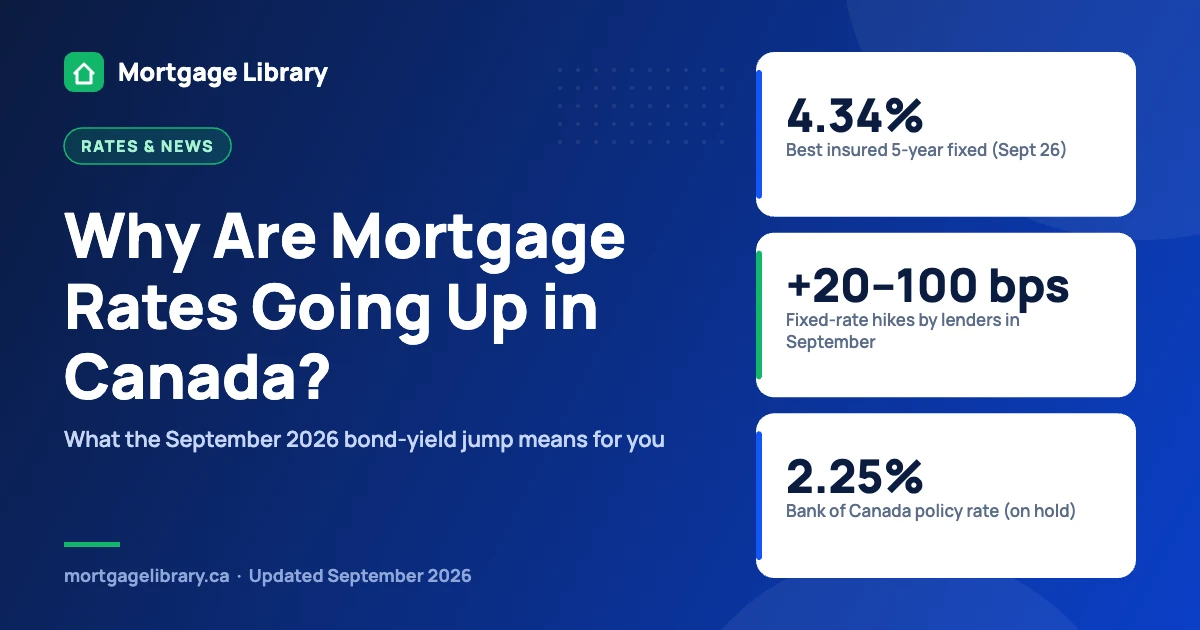
Yes, but only fixed rates. According to Canadian Mortgage Trends, lenders raised fixed rates by anywhere from 20 to almost 100 basis points (0.20% to 1.00%) in mid-September. Meanwhile, the major banks lifted posted fixed rates by about 10 to 20 basis points. In addition, some lenders quietly pulled back the discretionary discounts they had been offering.
As a result, the gap between the best fixed and variable rates has widened to roughly 0.85 to 1 percentage point. That gap matters, because it changes the fixed-versus-variable math for anyone choosing a mortgage this fall.
Why fixed mortgage rates are going up: bond yields
First, lenders fund five-year fixed mortgages with money that costs them roughly what a five-year Government of Canada bond pays, plus a margin. So when bond yields rise, fixed mortgage rates usually follow within days. In September, however, the five-year yield climbed about 25 basis points in a single week.
So why did yields rise? Several forces pushed at once:
- Sticky inflation. Canadian inflation has hovered near 3%, mostly because of gasoline prices, according to the Bank of Canada.
- Global bond markets. Canadian yields tend to move with U.S. Treasury yields, and U.S. rate expectations have also shifted higher.
- Trade and energy uncertainty. New U.S. tariffs and Middle East tensions have also made investors demand a higher return.
- Fewer rate cuts expected. Markets no longer expect the Bank of Canada to cut further. In fact, a few forecasters now see hikes.
How a bond market move reaches your mortgage
Bond yields rise
Investors demand higher returns on five-year Government of Canada bonds.
Lenders’ funding costs rise
Banks and monolines pay more to fund five-year fixed mortgages.
Fixed rates are repriced
Lenders raise posted and discounted fixed rates, often within a week.
New borrowers pay more
Buyers and renewing borrowers without a rate hold feel it first.
Why variable rates have not gone up
In contrast, variable rates are tied to your lender’s prime rate, which moves with the Bank of Canada’s policy rate. On September 2, 2026, however, the Bank held that rate at 2.25%. Therefore, prime stayed at 4.45% at the big banks, and variable rates did not change. Meanwhile, the next rate decision is on October 28, 2026.
To see exactly how a policy rate change flows through to your payment, read how a Bank of Canada rate change affects your mortgage payment.
Fixed vs. variable in September 2026
Fixed rates
- Follow five-year bond yields
- Rose 0.10% to 1.00% this month
- Payment locked for the term
- Higher penalty to break (IRD)
Variable rates
- Follow prime and the Bank of Canada
- Unchanged since the September 2 hold
- Payment or amortization can change
- Penalty usually three months’ interest
What mortgage rates going up means for your payment
Small rate changes still add up. For example, on a $500,000 mortgage with a 25-year amortization, every 0.25% increase adds about $68 to $70 a month. So over a five-year term, that is roughly $4,100 more in payments.
Monthly payment on a $500,000 mortgage (25-year amortization)
Who is affected when mortgage rates go up?
However, not everyone feels higher rates right away. Here is how it breaks down:
- Buyers with a rate hold: If you got a pre-approval before the increase, your rate is usually protected for 90 to 120 days.
- Buyers without a rate hold: Instead, you will be quoted the new, higher rates. In addition, a higher rate can reduce how much you qualify for under the mortgage stress test.
- Homeowners renewing soon: Your renewal offer will reflect current rates. However, most lenders let you lock a renewal rate up to 120 days early.
- Existing fixed-rate borrowers: Nothing changes until your term ends.
- Variable-rate borrowers: Nothing changes unless prime moves.
5 smart moves when mortgage rates are going up
You cannot control the bond market. Still, you can control your timing and your options.
- Lock in a rate hold now. A pre-approval or renewal rate hold is free, and it also does not commit you. If rates fall before you sign, ask the lender to match the lower rate.
- Start your renewal early. Begin about four months before your maturity date. Our mortgage renewal guide walks through each step.
- Shop other lenders. Discounts also vary widely right now. Since late 2024, you can switch lenders at renewal without re-qualifying under the stress test.
- Weigh variable or a shorter term. With a gap of close to 1% between fixed and variable, a variable rate or a shorter fixed term may therefore cost less. Compare both in our fixed vs. variable guide.
- Stress-test your own budget. Then check that you could handle a payment 1% higher. If not, build a cash buffer first.
Will mortgage rates keep going up?
Nobody knows for certain. Still, most big-bank economists expect the Bank of Canada to hold at 2.25% for the rest of 2026. Meanwhile, bond yields are expected to drift only modestly higher. We also break down every major forecast in our 2026–2027 mortgage rate forecast.
Frequently asked questions
Fixed mortgage rates follow five-year Government of Canada bond yields, not the Bank of Canada policy rate. Bond yields rose sharply in September 2026, so lenders raised fixed rates even though the Bank held its rate at 2.25%.
Not right now. Variable rates follow prime, which only changes when the Bank of Canada changes its policy rate. Prime is 4.45% at the big banks after the September 2 hold. The next decision is October 28, 2026.
When you are buying or renewing within four months, a free rate hold is usually a smart move. It protects you if rates keep rising, and most lenders will give you a lower rate if rates fall before you close.
On a $500,000 mortgage with a 25-year amortization, a 0.25% increase adds roughly $68 to $70 per month, or about $4,100 over a five-year term.
Sources: Bank of Canada, Sept 2, 2026 rate announcement · Canadian Mortgage Trends · Ratehub.ca best 5-year fixed rates · FCAC: Choosing a mortgage