A reverse mortgage lets Canadians aged 55 and older turn part of their home equity into cash, without selling and without making monthly payments. For many retirees, that sounds ideal. However, the interest keeps adding up, so the loan can grow quickly and eat into the equity you leave behind.
So this guide explains how a reverse mortgage works in Canada, who qualifies, what it costs and how it compares with other options.
How does a reverse mortgage work?
With a regular mortgage, you pay the lender every month. With a reverse mortgage, however, the lender pays you, either as a lump sum, in scheduled payments or both. Meanwhile, interest is added to your balance instead of being paid monthly.
Also, you keep ownership of your home. So as long as you pay property taxes, keep the home insured and maintain it, you can generally stay for as long as you like.
How the loan works over time
Apply to a lender
The lender looks at your age, your home’s value and its location, rather than your income.
Receive the money
You take a lump sum, regular advances or a combination, and it is tax-free because it is a loan.
Interest builds up
Instead of monthly payments, interest is added to the balance, so the debt grows.
The loan is repaid
When you sell, move out permanently or the last borrower passes away, the home’s sale repays the loan.
Who qualifies for a reverse mortgage in Canada?
According to the Financial Consumer Agency of Canada, you generally must:
- Be at least 55 years old, and so must your spouse if you are both on title.
- Live in the home as your primary residence for at least six months a year.
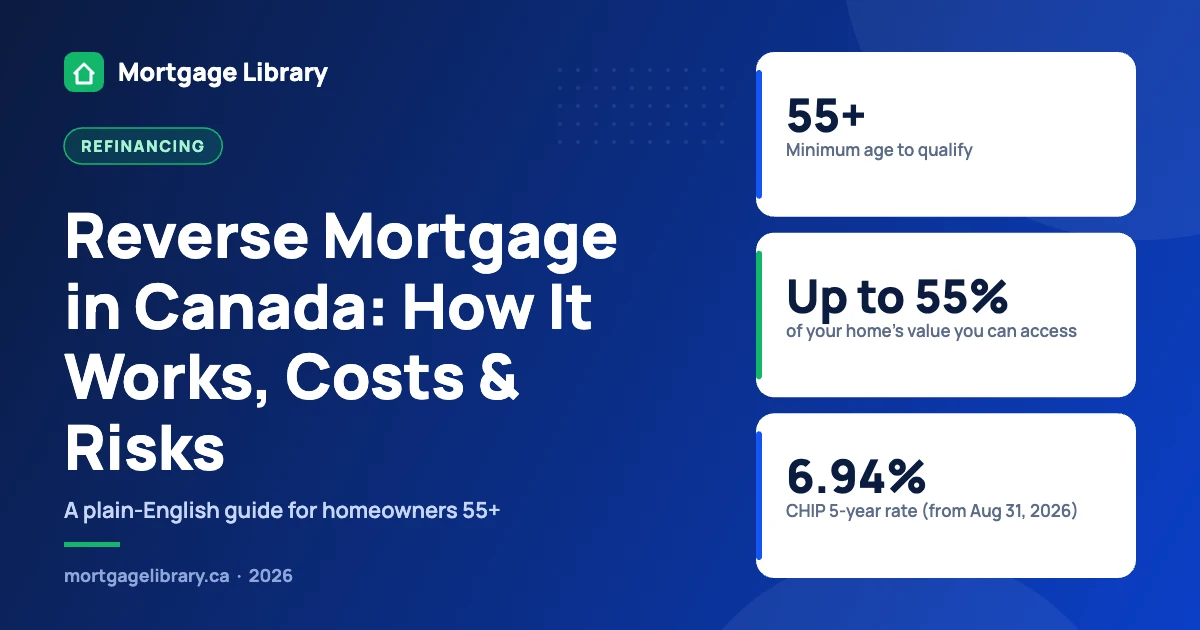
- Have enough equity, because you can borrow up to 55% of your home’s current value.
The exact amount also depends on your age, the property type and where you live. For example, a 70-year-old with an $800,000 home in a major city might qualify for more than a 57-year-old with the same home. In Canada, the main lenders are HomeEquity Bank, which offers CHIP, and Equitable Bank.
How much does a reverse mortgage cost?
These loans cost more than regular mortgages or HELOCs. For instance, HomeEquity Bank raised its CHIP five-year rate from 6.39% to 6.94% on August 31, 2026, as bond yields climbed. In addition, you may pay appraisal, legal and setup fees, which are usually added to the loan.
Because interest compounds and you make no payments, the balance grows quickly. Here is how a $200,000 reverse mortgage would grow at 6.94%:
How a $200,000 balance grows at 6.94%
In other words, the debt roughly doubles in about 10 years. So the longer you keep the loan, the less equity remains for you or your heirs.
Pros and cons for retirees
Is it right for you?
Pros
- No monthly payments required
- Stay in your home
- Tax-free cash
- No income test to qualify
Cons
- Higher interest rates
- Balance grows quickly
- Less equity for your estate
- Fees and possible prepayment penalties
Reverse mortgage vs. HELOC vs. downsizing
Before you choose one, compare it with the alternatives. For example, a HELOC has a much lower rate, although you need enough income to qualify and make at least interest payments. Similarly, a refinance can free up cash at regular mortgage rates.
Alternatively, downsizing unlocks equity with no debt at all, although moving has its own costs. Therefore, the best choice depends on your income, your health, how long you plan to stay and what you want to leave to your family.
Finally, the FCAC recommends getting independent legal and financial advice before signing. So involve your family early, too, because the decision affects your estate.
Frequently asked questions
These rates are higher than regular mortgage rates. HomeEquity Bank’s CHIP five-year rate rose to 6.94% on August 31, 2026, so check current rates with each lender before applying.
There is no required monthly payment. Instead, interest is added to the balance, and the loan is repaid when you sell, move out permanently or the last borrower passes away.
It is a U.S. rule that lets heirs repay a government-insured loan for 95% of the home’s appraised value. It does not apply in Canada.
Up to 55% of your home’s current value, depending on your age, the home’s type and its location.
Sources: FCAC: Reverse mortgages · HomeEquity Bank: CHIP rates · Rate report (Sept 2026)