If you locked in a low five-year fixed rate in 2021, your renewal is probably arriving now. For many Canadians, that means renewal payment shock: a monthly payment that jumps by hundreds of dollars overnight. However, a bigger payment is not your only option.
So this guide shows how large the increase could be, why it is happening and six practical ways to soften the blow before you sign.
What is renewal payment shock?
Renewal payment shock is the jump in your mortgage payment when your term ends and you renew at a higher rate. It happens because most Canadian mortgages have a five-year term but a 25-year amortization. As a result, you renegotiate your rate several times before the loan is paid off.
Borrowers who locked in around 2% during 2020 and 2021 are now renewing at roughly 4% or more. So even though their balance is smaller, their payment usually rises.
How big is mortgage renewal payment shock in 2026?
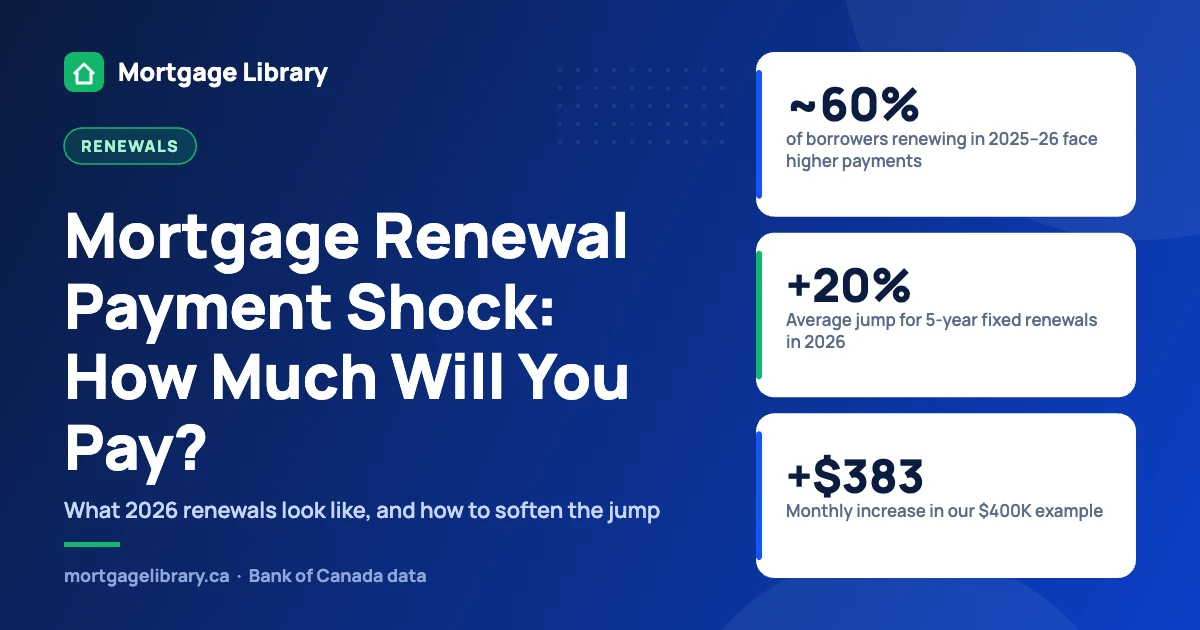
The Bank of Canada estimates that about 60% of mortgage holders renewing in 2025 and 2026 will see a payment increase. In particular, borrowers with five-year fixed mortgages renewing in 2026 face an average increase of about 20%.
On the other hand, some borrowers will pay less. For instance, many people on short-term fixed rates, or on variable mortgages with fixed payments, are renewing into similar or lower payments.
Example: renewal payment shock on a $400,000 mortgage
For example, consider a borrower who took out a $400,000 mortgage in 2021 at 1.99%, with a 25-year amortization. After five years, the balance is about $335,000. Now they renew at 4.29%, while 20 years remain.
Monthly payment before and after renewal
In other words, the payment rises by about $383 a month, or 23%. However, by resetting the amortization to 25 years, the increase shrinks to about $123 a month. That trade-off is at the heart of every renewal decision.
6 ways to reduce renewal payment shock
- Start early. Many lenders let you lock a renewal rate 120 days before maturity. Also, federally regulated lenders must send your renewal statement at least 21 days before your term ends, according to the FCAC. Don’t wait for it.
- Shop other lenders. Since November 2024, you can switch lenders at renewal without passing the stress test again, as long as you keep the same balance and amortization.
- Extend your amortization. Stretching back to 25 or 30 years lowers the payment. However, you will pay more interest overall, so treat it as a tool, not a habit.
- Make a lump-sum payment first. Renewal is usually the one time you can prepay any amount without a penalty. Even $20,000 can noticeably reduce your new payment.
- Compare terms and rate types. With variable rates about 1% below fixed, a variable or shorter fixed term may cost less. Our fixed vs. variable guide explains the trade-offs.
- Rework your budget now. Start setting aside the difference today, so the new payment feels familiar when it arrives.
What if you can’t afford the new payment?
First, call your lender early, before you miss a payment. Lenders have tools for borrowers under pressure, including amortization extensions, temporary payment changes and blending your rate. In addition, the FCAC expects federally regulated lenders to offer relief to borrowers at risk.
Also, consider tapping other resources. For example, a refinance can consolidate higher-interest debt, which frees up cash flow. When the numbers still do not work, speak with a mortgage professional before your renewal date.
Will renewal payment shock ease in 2027?
Probably, but only slowly. That is because most 2020 and 2021 low-rate mortgages will have renewed by the end of 2026. After that, fewer borrowers will be jumping from 2% to 4%. Meanwhile, forecasts point to steady rates, as covered in our mortgage rate forecast. For step-by-step instructions, see our mortgage renewal guide.
Frequently asked questions
It depends on your old rate, new rate and remaining amortization. The Bank of Canada estimates that five-year fixed borrowers renewing in 2026 face an average increase of about 20%. For example, a $400,000 mortgage taken at 1.99% in 2021 would rise by about $383 a month when renewed at 4.29%.
Often, yes. Many lenders will reset your amortization to 25 years, and sometimes 30 years for uninsured mortgages. However, a longer amortization means more interest over the life of the loan.
Not for a straight switch. Since November 2024, uninsured borrowers who keep the same balance and amortization do not need to requalify under the stress test when they switch lenders.
About four months before your maturity date, because many lenders will hold a renewal rate for up to 120 days.
Sources: Bank of Canada staff analytical note 2025-21 · FCAC: Renewing your mortgage · OSFI: Straight switch exemption