The FHSA, or First Home Savings Account, is the most powerful savings tool Canadian first-time buyers have. Contributions are tax-deductible like an RRSP, while withdrawals for a first home are tax-free like a TFSA. However, the rules around who can open one, how much you can add and what happens if you never buy trip up a lot of people.
So this guide covers the key FHSA rules for 2026, with examples, so you can make the most of your account.
What is an FHSA?
The FHSA is a registered account created by the federal government in 2023 to help Canadians save for their first home. According to the Canada Revenue Agency, it combines two tax breaks in one account. As a result, every dollar you contribute works harder than it would in a regular savings account.
How the FHSA compares
FHSA
- Contributions are tax-deductible
- Home withdrawals are tax-free
- No repayment required
- $40,000 lifetime limit
RRSP Home Buyers’ Plan
- Contributions are tax-deductible
- Withdraw up to $60,000 tax-free
- Must repay over 15 years
- Uses your retirement savings
TFSA
- No tax deduction
- Tax-free withdrawals for anything
- Room comes back the next year
- Flexible, but no upfront refund
Who can open one?
To open an account, you must meet all of these conditions, as set out on the CRA eligibility page:
- You are a resident of Canada.
- You are at least 18 (19 in some provinces) and no older than 71 on December 31 of the year you open it.
- You are a first-time home buyer. In other words, you did not live in a home that you or your spouse owned at any time in the current year or the previous four calendar years.
FHSA contribution limits for 2026
The main limits are simple. However, the carry-forward rule is where most of the value hides.
- Carry-forward: If you contribute less than $8,000 in a year, you can carry the unused room forward. However, you can only carry forward up to $8,000, so the most you can add in one year is $16,000.
- Deadline: Unlike an RRSP, contributions must be made by December 31 to count for that tax year.
- Deductions: You can claim the deduction in the year you contribute, or save it for a later year when your income is higher.
- Time limit: Your account must also be closed by the end of the 15th year after you opened it, or the year you turn 71, whichever comes first.
How much can your savings grow?
For example, say you contribute the full $8,000 each year for five years and earn 5% a year. So by the end, your account would hold roughly $46,400. In addition, if you are in a 30% tax bracket, your deductions would return about $12,000 in tax refunds along the way.
Five years of maximum FHSA contributions
How to withdraw from your FHSA to buy a home
Above all, a qualifying withdrawal is completely tax-free. To make one, you generally must:
Making a qualifying FHSA withdrawal
Still be a first-time buyer
You must meet the first-time home buyer test when you withdraw.
Have a written agreement
You need an agreement to buy or build a qualifying home before October 1 of the year after the withdrawal.
Plan to live there
You must intend to occupy the home as your principal residence within one year of buying or building it.
Complete Form RC725
Your financial institution then processes the withdrawal once you submit the request.
Also, you can combine this withdrawal with the RRSP Home Buyers’ Plan for the same home. So a single buyer could access up to $100,000, and a couple could access up to $200,000. That can make a big dent in the down payment and even help you avoid CMHC insurance.
What happens to your FHSA if you don’t buy a house?
This is the question most people worry about, but the answer is reassuring. When you decide not to buy, you have two options:
- Transfer to an RRSP or RRIF. The money moves tax-free, and it also does not use up your RRSP contribution room.
- Withdraw the cash. In this case, the withdrawal is taxed as income, so it is usually the less attractive option.
In other words, the account has very little downside. Even when plans change, your savings can still become retirement savings without a tax hit.
Common questions and mistakes
- Can I use my FHSA to buy an investment property? No. The home must instead be your principal residence. However, you can later rent it out after you move on, as covered in our rental property mortgage guide.
- Can I buy my first home without an FHSA? Yes. The FHSA is optional, but it is usually worth opening, because the tax savings are significant.
- Can I hold investments? Yes. Just like a TFSA, it can also hold cash, GICs, stocks, bonds and ETFs.
- Watch for over-contributions. Excess amounts face a 1% monthly tax, so track your room carefully.
Frequently asked questions
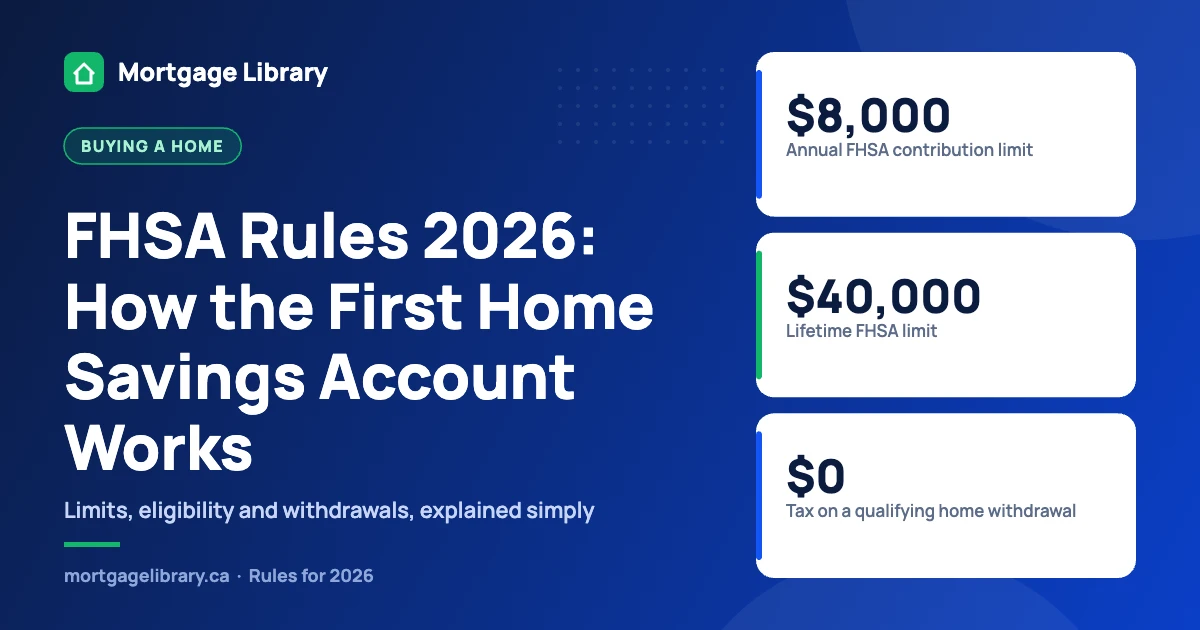
You can contribute up to $8,000 a year, plus up to $8,000 of unused room carried forward from the previous year, for a maximum of $16,000 in a single year. The lifetime limit is $40,000.
You can transfer the balance to your RRSP or RRIF tax-free without using RRSP room, or you can instead withdraw it as taxable income.
No, because a qualifying withdrawal requires that you intend to live in the home as your principal residence within one year of buying or building it.
Yes. You can combine both for the same home, so a single buyer could use up to $40,000 from an FHSA plus $60,000 from the Home Buyers’ Plan.
Sources: CRA: First Home Savings Account · CRA: Opening your FHSA · CRA: Home Buyers’ Plan