What if the Canada Revenue Agency helped you pay off your mortgage faster? It sounds like a gimmick, but it rests on a plain rule in Canadian tax law: when you borrow money to earn investment or business income, the interest is generally tax deductible. Interest on the mortgage for your own home is not.
The Smith Manoeuvre uses that difference. Month by month, it converts your non-deductible mortgage into a tax-deductible investment loan, and the tax refunds it creates go back against your mortgage. So with tax season wrapping up on April 30, here is how it works, what CRA actually requires, what it could save you, and the other CRA-friendly strategies worth knowing.
Why the CRA rule matters
In the U.S., homeowners can deduct mortgage interest. In Canada, you can’t. Every dollar of interest on your home mortgage is paid with after-tax money. So at a 40% marginal tax rate, you need to earn about $1,667 before tax to pay $1,000 of mortgage interest.
However, the Income Tax Act lets you deduct interest on money you borrow to earn income from a business or property. CRA explains its position in Income Tax Folio S3-F6-C1, Interest Deductibility, and you claim the interest on line 22100 (carrying charges and interest expenses) of your return. The key test is how the borrowed money is used, not what secures the loan. So a loan secured by your home can still be deductible if the money is invested.
In short, the goal is to own the same home and carry roughly the same total debt, but to make the interest on that debt work for you at tax time.
How the Smith Manoeuvre works, step by step
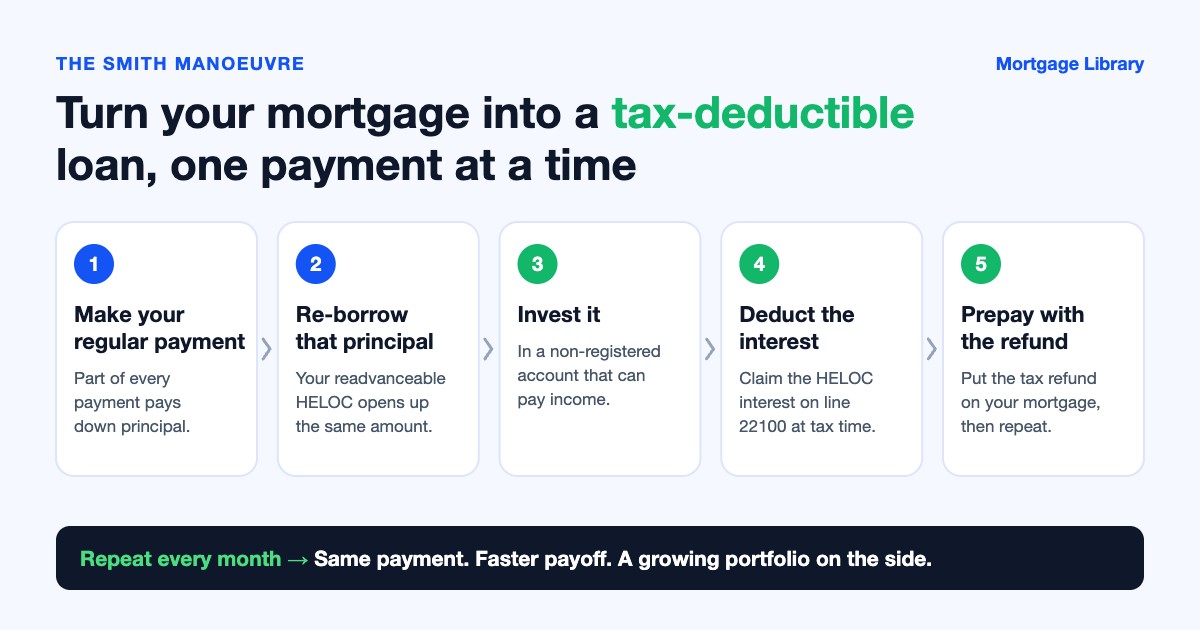
The strategy was popularized by the late Fraser Smith, a B.C. financial planner. It needs one key product: a readvanceable mortgage. That is a regular amortizing mortgage bundled with a home equity line of credit (HELOC) whose limit grows automatically as you pay down principal. Most big banks offer one under names like a home equity plan or a flex line.
- Make your regular mortgage payment. Part of every payment reduces your principal.
- Re-borrow the principal you just paid. The HELOC limit goes up by the same amount, so you borrow it back right away.
- Invest it in a non-registered account. Choose investments that can reasonably be expected to produce income, such as dividend-paying stocks or funds.
- Deduct the HELOC interest at tax time. Because the loan was used to invest, its interest is generally deductible.
- Put your tax refund on the mortgage. Make a lump-sum prepayment, then re-borrow and invest that amount too.
- Repeat. Over time, your non-deductible mortgage shrinks to zero while your deductible investment loan and your portfolio grow.
Your total debt stays roughly the same, but its mix changes. As a result, the mortgage you can’t deduct disappears faster, and the debt that remains is the deductible kind.
Example: a $500,000 mortgage
Let’s look at a household with a $500,000 mortgage at 4.29%, amortized over 25 years. The payment is about $2,709 a month. In the first year, about $11,500 of those payments goes to principal and about $21,000 goes to interest.
Now assume they follow the Smith Manoeuvre with a HELOC at 4.95% and a 40% marginal tax rate. Their portfolio earns 6% a year: a 2% dividend that helps pay the HELOC interest and 4% growth. Any interest the dividends don’t cover is borrowed from the HELOC, so their total debt never goes above the original $500,000. They also put every refund on the mortgage.
Estimated yearly tax refund from deductible interest
The refunds start small, because the investment loan starts small. However, they snowball. By year 20, the deductible interest is producing a refund of over $8,000 a year.
- Mortgage paid off: in about 21½ years instead of 25, with the same monthly payment.
- Total refunds over that time: roughly $80,000, all applied to the mortgage.
- At that point: the regular plan still owes about $103,000 on the mortgage. The Smith Manoeuvre plan owes nothing on the mortgage, but it still has a $500,000 HELOC, now fully tax-deductible, and a portfolio worth roughly $560,000 before tax.
Notice that last point. The Smith Manoeuvre doesn’t erase debt. Instead, it swaps bad debt for deductible debt and builds a portfolio alongside it. If investment returns come in lower than the HELOC rate after tax, the result can be worse than simply paying down your mortgage.
What CRA requires for the interest to be deductible
The tax rules are the part people get wrong most often. To keep your deduction safe, follow these rules:
- Trace every dollar. The borrowed money must go straight from the HELOC into the investment account. CRA looks at the direct, current use of the funds.
- Never mix personal spending. If you use the investment HELOC for a vacation or a car, part of the interest is no longer deductible, and messy records can put the whole deduction at risk. Ideally, keep a separate HELOC sub-account just for investing.
- Invest for income. CRA requires a reasonable expectation of income from the investment. Its line 22100 guidance says you can’t deduct interest if the only thing the investment can earn is capital gains. Dividend-paying stocks and funds are the common choice.
- Use non-registered accounts only. Interest on money borrowed to contribute to an RRSP, TFSA or FHSA is not deductible.
- Watch return-of-capital distributions. Some funds pay out part of your own capital. If you spend it, that portion of the loan may no longer qualify. So reinvest it or use it to pay down the HELOC.
- Keep records. Save your HELOC and brokerage statements every year, in case CRA asks.
Canadian courts have backed this kind of planning. In the 2001 Singleton case, the Supreme Court of Canada allowed an interest deduction where a taxpayer rearranged his borrowing so that the debt was tied to an income-earning use. CRA’s folio reflects that line of cases.
The mortgage has to be set up properly
Your mortgage structure makes or breaks this strategy. Here is what to look for:
- A readvanceable mortgage. Without one, you’d have to apply for more credit every time you want to re-borrow.
- Enough equity. For federally regulated lenders, the revolving HELOC portion can’t exceed 65% of your home’s value, and the combined mortgage and HELOC generally can’t exceed 80%. See OSFI Guideline B-20 and the FCAC guide to HELOCs.
- Separate sub-accounts. One for investing and one for anything else, so your records stay clean.
- Prepayment room. Check your prepayment privileges so you can apply your tax refund as a lump sum without a penalty.
If your current mortgage isn’t readvanceable, you may need to switch at renewal or refinance. Switching mid-term can trigger a prepayment penalty, so renewal is usually the cheapest time to restructure. A mortgage broker can compare readvanceable products across lenders.
Risks to weigh before you start
- Market risk. A downturn can leave your portfolio worth less than your investment loan for years.
- Rate risk. HELOCs are variable. If prime rises, your interest cost rises too. See fixed vs variable rates for how that works.
- Behaviour risk. Selling in a panic or dipping into the HELOC for spending can undo years of progress.
- Tax risk. Sloppy records or the wrong investments can cost you the deduction.
- Income risk. If you lose your job, you still have a large line of credit to service.
Is the Smith Manoeuvre a fit?
Often a good fit
- Stable income and an emergency fund
- A higher marginal tax rate
- A long time horizon (10+ years)
- Comfort with market swings
- RRSP and TFSA room already used or planned
Probably skip it
- Tight monthly budget or unstable income
- Low tax bracket (the refund is smaller)
- Plans to sell or retire soon
- Would lose sleep in a market drop
- Would be tempted to spend the HELOC
Other ways the CRA can help you pay off your mortgage
The Smith Manoeuvre isn’t the only option. These strategies also use the tax system to speed up your payoff.
1. Put your RRSP refund on your mortgage
This is the simplest version. Contribute to your RRSP, then use the refund for a lump-sum prepayment. For 2026, the RRSP dollar limit is $33,810, or 18% of your previous year’s earned income if lower. At a 40% marginal rate, a $10,000 contribution can produce about $4,000 that goes straight onto your mortgage. For the full comparison, read pay down your mortgage or invest.
2. Cash damming (self-employed and rental owners)
If you run a business or own a rental property, cash damming can be faster than the Smith Manoeuvre. You use your business or rental income to pay down your home mortgage. Then you pay the business or rental expenses with the HELOC. Because that HELOC money is used to earn income, its interest is generally deductible. This works well for self-employed borrowers, but get an accountant to set it up.
3. The debt swap
If you already own non-registered investments and also have a mortgage, you can sell the investments, use the cash to pay down the mortgage, then re-borrow to buy investments again. This mirrors the Singleton case. Watch out for capital gains tax when you sell, and for the superficial loss rule if you sell at a loss and buy back within 30 days.
4. Rent out part of your home
If you rent out a basement suite or a room, the share of mortgage interest tied to the rented space is generally deductible against the rental income. For example, if the suite is 30% of the home, about 30% of the interest may qualify. As a result, the rent and the deduction both help you prepay faster.
5. For buyers: start with a smaller mortgage
The FHSA lets first-time buyers contribute $8,000 a year (up to $40,000) with a tax deduction, and withdraw tax-free for a home. The RRSP Home Buyers’ Plan lets you withdraw up to $60,000 from your RRSP for a down payment. A bigger down payment means a smaller mortgage from day one. See CRA’s FHSA and Home Buyers’ Plan pages for the rules.
Bottom line
The Smith Manoeuvre doesn’t use a loophole. It simply follows CRA’s interest deductibility rules, so the tax refunds help pay down your mortgage faster. Done right, it can shave years off your mortgage and build a portfolio on the side. However, it adds leverage and paperwork, and it only works with the right mortgage. So talk to a tax professional and a mortgage professional before you start.
Mortgage Library is an independent educational resource. This article is general information, not tax, legal or investment advice. Tax rules change, so confirm your situation with a qualified professional.
Frequently asked questions
Yes. It follows the Income Tax Act rule that interest on money borrowed to earn income from a business or property is generally deductible. CRA explains its approach in Income Tax Folio S3-F6-C1. The key is tracing the borrowed money directly to income-producing investments.
Not on your own home. Interest on a mortgage used to buy your principal residence is not deductible. However, interest on money you borrow to invest, run a business or earn rental income generally is, even if the loan is secured by your home.
It depends on your tax rate, interest rates and investment returns. In our $500,000 example, the mortgage was paid off in about 21½ years instead of 25 with the same monthly payment. However, results vary, and investment losses can reduce or erase the benefit.
You need a readvanceable mortgage with a HELOC that grows as you pay down principal, enough home equity, a non-registered investment account, and careful records. Most people also work with an accountant and a mortgage professional.
You can, but the interest will not be deductible. Interest on money borrowed to contribute to an RRSP, TFSA or FHSA does not qualify. The Smith Manoeuvre only works with a non-registered account.
The Smith Manoeuvre re-borrows the mortgage principal you pay down and invests it. Cash damming uses business or rental income to pay down the mortgage, then pays the business or rental expenses with a HELOC. Both turn non-deductible debt into deductible debt.
Sources: CRA: Income Tax Folio S3-F6-C1, Interest Deductibility · CRA: Line 22100, Carrying charges and interest expenses · OSFI: Guideline B-20 · FCAC: Home equity lines of credit · CRA: Home Buyers’ Plan · CRA: First Home Savings Account