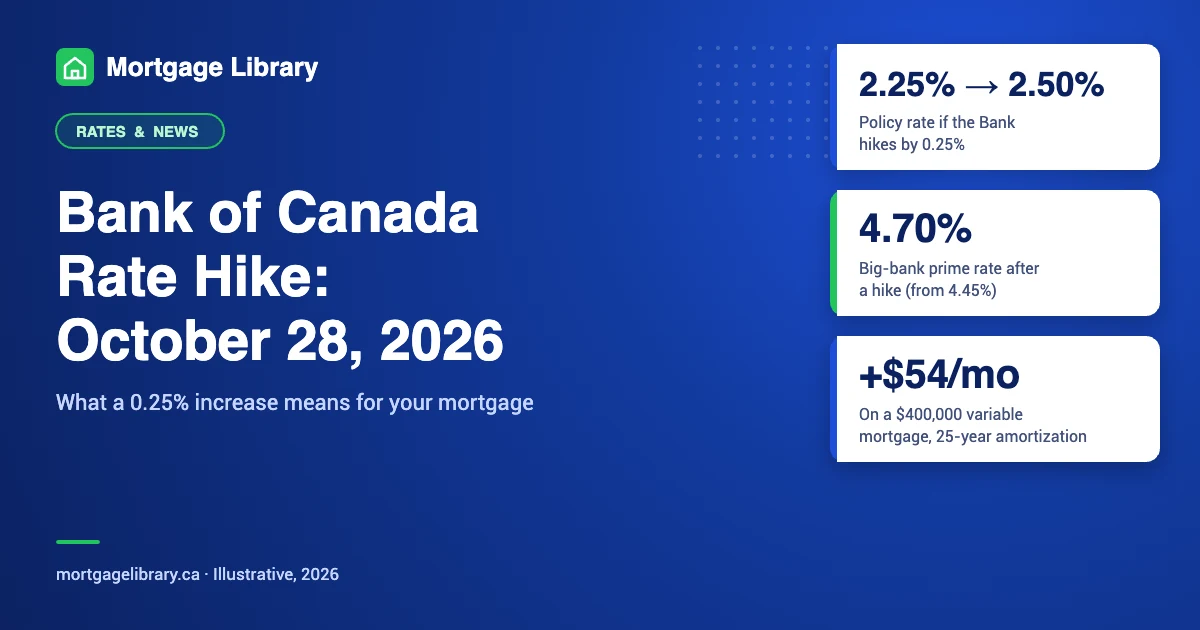
The Bank of Canada raised rates on Wednesday, October 28, 2026, lifting its target for the overnight rate by 0.25% (25 basis points) to 2.5%. It is the first Bank of Canada rate hike since July 2023 and the Bank’s first move of any kind since it cut rates on October 29, 2025. The decision came with the Bank’s quarterly Monetary Policy Report, and the new rate takes effect October 29.
So if you have a variable-rate mortgage, a HELOC or a renewal coming up, this guide explains what changed, why the Bank acted and exactly what the hike will cost you.
What the Bank of Canada decided on October 28
Here is what the Bank announced:
- New policy rate: 2.5%, up from 2.25%. The Bank Rate is now 2.75% and the deposit rate is 2.45%.
- Effective date: October 29, 2026.
- First hike since July 2023: the rate had been 2.25% since October 29, 2025, through seven straight holds.
- Why: to reduce the risk that continuing high energy prices spread broadly to the prices of other goods and services.
- What’s next: “There could be a need to increase the policy rate further, but given uncertainties, Governing Council agreed to proceed carefully.”
The move was largely expected. In the days before the decision, futures and swaps priced roughly a 78% to 87% chance of a quarter-point hike, and a Reuters poll taken October 21 to 23 found 19 of 34 economists (56%) expected one.
The Bank’s new forecast
The October Monetary Policy Report shows why the Bank is concerned:
- Inflation: CPI inflation has been around 3% since April. The Bank expects it to rise to about 3.5% by the end of 2026, average 3% in 2027 and come back down to 2% in mid-2028.
- Underlying inflation: excluding gasoline, inflation was 2.2% in September, and the Bank’s core measures are close to 2%.
- Growth: GDP grew 3.3% in the second quarter and about 2% in the third, but is expected to slow in the fourth quarter because of new US tariffs. The Bank sees growth of 1% in 2026 and 2% in both 2027 and 2028.
- Jobs and housing: unemployment is around 6.5%, and the housing market is expected to remain relatively weak.
Why the Bank of Canada raised rates
1. Inflation is back above 3%
Canada’s annual inflation rate rose to 3.1% in September, up from 3.0% in August, according to Statistics Canada. That is well above the Bank’s 2% target.
2. Energy prices are driving it
The biggest culprit is energy. Gasoline prices were up 27.8% year over year in September, and energy overall was up 19%, as the war in Iran keeps oil prices high. The Bank raised rates to reduce the risk that these costs spread into everything else, from groceries to shipping to airfare, especially with the Middle East conflict now in its eighth month.
3. The Governor changed his tone
Expectations shifted quickly. Before mid-October, markets saw only about a one-in-three chance of an October hike. Then, at IMF meetings, Governor Tiff Macklem signalled that higher global energy prices would push the Bank’s inflation forecasts up. Within days, the odds of a hike jumped above 75%.
4. Rates were low by historical standards
At 2.25%, the policy rate sat at the low end of what the Bank considers “neutral.” With inflation above 3%, some economists argued that real, inflation-adjusted rates were negative. Therefore, the Bank had room to tighten without crushing the economy.
Why the Bank is moving carefully
However, the Bank also said it will proceed carefully, and there are good reasons not to rush another hike:
- Underlying inflation is calmer. Excluding gasoline, inflation was just 2.2% in September, down from 2.4% in August. So the problem is mostly energy, not the broad economy.
- The job market is weakening. Canada lost 68,000 jobs in September, erasing the gains made earlier in the year.
- Trade uncertainty. Ongoing trade tensions make the Bank cautious about adding pressure to an already soft economy.
- The housing market is weak. A hike would weigh further on buyers and sellers heading into winter.
Before the decision, most forecasters saw the rate reaching about 2.50% to 2.75% by early 2027. With the rate now at 2.5%, one more hike is possible, but the Bank’s cautious tone suggests it will watch the data before moving again on December 9.
What the 0.25% rate hike means for your mortgage
Prime rate
Canada’s big banks typically move their prime rate by the same amount as the Bank of Canada, usually effective the next day. Prime was 4.45% and is expected to rise to 4.70% as the big banks match the move.
Rates before and after the October 28, 2026 hike
| Scenario | Policy rate | Prime rate | Variable mortgage (prime − 0.50%) | HELOC (prime + 0.50%) |
|---|---|---|---|---|
| Before the hike | 2.25% | 4.45% | 3.95% | 4.95% |
| After the 0.25% hike | 2.50% | 4.70% | 4.20% | 5.20% |
| If the Bank hikes again (0.50% total) | 2.75% | 4.95% | 4.45% | 5.45% |
Variable-rate mortgage payments
If you have an adjustable-payment variable mortgage, your payment rises almost right away. Here is roughly what the hike adds each month, based on 25 years remaining and a starting rate of 3.95%:
Monthly payment on a variable mortgage after the rate hike
| Mortgage balance | Payment before the hike (3.95%) | After the 0.25% hike (4.20%) | If the Bank hikes again (0.50% total) |
|---|---|---|---|
| $400,000 | $2,093 | $2,148 (+$54) | $2,203 (+$110) |
| $600,000 | $3,140 | $3,222 (+$82) | $3,304 (+$164) |
| $800,000 | $4,187 | $4,295 (+$109) | $4,406 (+$219) |
On the other hand, if you have a fixed-payment variable mortgage, your payment stays the same. Instead, more of it goes to interest and less to principal. And if rates keep rising, you could eventually reach your trigger rate, where your payment no longer covers the interest.
HELOCs and lines of credit
Every 0.25% increase in prime adds about $21 a month in interest for every $100,000 you owe on a HELOC. For more detail, see our guide to HELOCs in Canada.
Fixed-rate mortgages
If you are in a fixed-rate term, nothing changes until renewal. However, new fixed rates do not follow the Bank of Canada directly. Instead, they follow Government of Canada bond yields. The 5-year yield climbed from about 3.2% in late August to roughly 3.6% in mid-October, so fixed rates were already rising ahead of the decision.
What to do now
If your mortgage renews in the next 4 months
Get a rate hold now. Also, do not simply sign your lender’s renewal letter. Compare offers first, because lenders must send your renewal statement at least 21 days before your term ends. Our step-by-step guide to mortgage renewal in Canada walks you through it.
If you have a variable rate and are thinking about locking in
Locking in is a budget decision, not a forecast. So ask yourself: could I comfortably handle a payment that is $100 to $200 higher per month? If not, converting to a fixed rate may give you peace of mind. But if you have room in your budget, staying variable may still make sense. Before breaking a mortgage to switch, read about prepayment penalties.
If you are buying a home
Get pre-approved with a rate hold before rates move further. Then stress-test your budget at 0.25% to 0.50% above the rate you are quoted. If you are comparing lenders, see our breakdown of mortgage brokers vs. banks.
If you are debating paying down debt
Rising rates make extra payments on variable debt more valuable. For the full math, see whether you should pay down your mortgage or invest.
What to watch next
- Prime rate changes: the big banks are expected to raise prime to 4.70%, usually effective the next day.
- Inflation reports: monthly CPI data from Statistics Canada, especially energy prices and core inflation.
- Energy prices: oil remains high while the Middle East conflict continues.
- Next rate decision: December 9, 2026. Official statements are posted on the Bank of Canada website.
- Next Monetary Policy Report: January 27, 2027.
Frequently asked questions
The next decision is Wednesday, December 9, 2026, the final one of the year. The next Monetary Policy Report comes out on January 27, 2027.
The policy rate is 2.5%. The Bank raised it from 2.25% on October 28, 2026, effective October 29. It was the first hike since July 2023.
For an adjustable-payment variable mortgage with 25 years left, the 0.25% hike adds about $54 a month on a $400,000 balance and about $82 a month on a $600,000 balance.
Not directly. Fixed rates follow 5-year Government of Canada bond yields, which had already risen ahead of the hike. Meanwhile, existing fixed-rate mortgages do not change until renewal.
Prime is expected to rise from 4.45% to 4.70% as the big banks match the move, usually effective the next day.
The Bank said it acted to reduce the risk that continuing high energy prices spread broadly to the prices of other goods and services. Inflation was 3.1% in September, and the Bank expects it to reach about 3.5% by the end of 2026.
This article is for educational purposes only and is not financial advice. Rates and forecasts can change quickly, so speak with a licensed mortgage professional about your situation. See our editorial standards.