Every buyer and homeowner wants the same thing from a mortgage rate forecast: a clear sense of whether to lock in now or wait. Since fixed rates jumped in September 2026, that question feels more urgent. So we pulled together what Canada’s big-bank economists are predicting for 2026 and 2027.
We also answer the question people search most often: will mortgage rates drop to 3% again? Here is what the forecasts say, and what they mean for your next move.
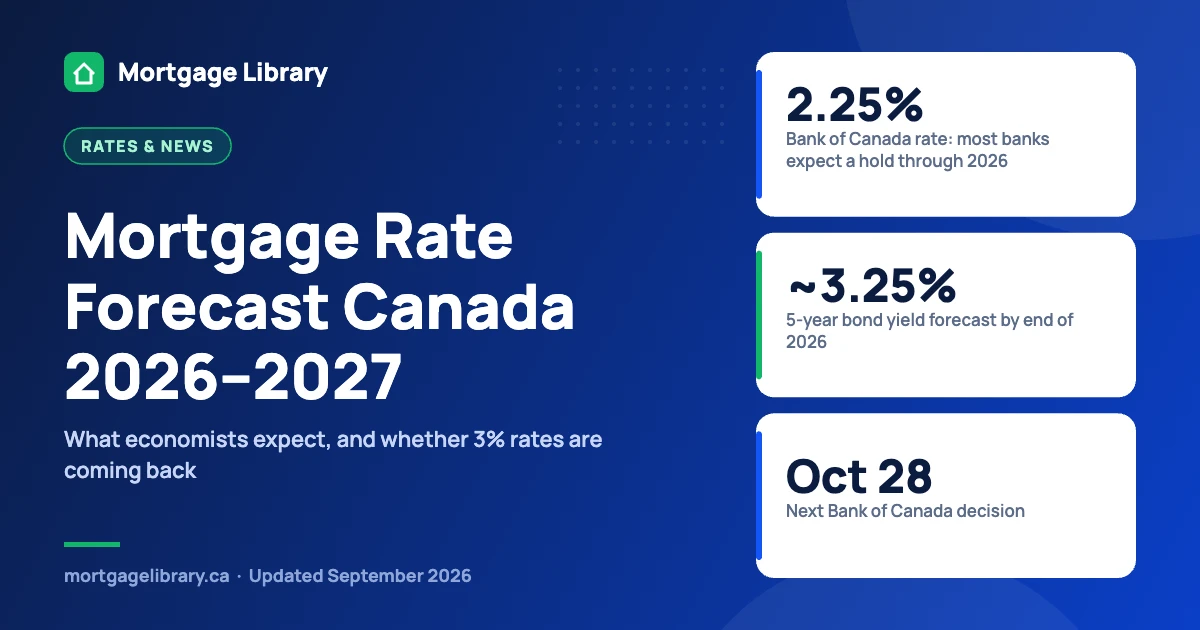
The short version: our mortgage rate forecast for 2026–2027
Mortgage rates come in two flavours, and each has a different driver. First, variable rates follow the Bank of Canada policy rate. In contrast, fixed rates follow five-year Government of Canada bond yields. So any useful mortgage rate forecast has to look at both.
What economists expect for the Bank of Canada
Bank of Canada policy rate forecasts
| Forecaster | End of 2026 | 2027 outlook |
|---|---|---|
| BMO, CIBC, RBC, TD | 2.25% (hold) | Mostly 2.25%–2.75% |
| Scotiabank, National Bank | 2.75% (hikes) | Varies |
| RBC (most hawkish for 2027) | 2.25% | Up to 3.25% by late 2027 |
In other words, the base case is a long pause. However, a few economists now expect hikes rather than cuts. That is a big shift from a year ago, when most forecasts pointed down.
What economists expect for fixed rates
Five-year bond yields started 2026 near 3.0% and are forecast to reach about 3.25% by year-end, according to nesto’s forecast roundup. For 2027, forecasts then range from about 2.90% to 3.45%. As a result, most forecasters expect fixed mortgage rates to stay near today’s levels, with a slight upward bias.
Meanwhile, the Bank of Canada itself has flagged inflation risks from high energy prices. That is also one reason bond markets have pushed yields higher. For the full story behind this month’s jump, read why mortgage rates are going up.
Will mortgage rates drop to 3% again?
It depends on which rate you mean. For a five-year fixed rate, however, 3% is a long way off. Lenders typically price five-year fixed mortgages about 1.1% to 1.6% above the five-year bond yield. So a 3% fixed rate would need yields to fall to roughly 1.5% to 1.9%. Historically, that tends to happen only during a recession or a financial shock.
In contrast, a 3% variable rate is closer. Today’s best variable rates sit about 1.05% to 1.15% below prime. Therefore, the Bank of Canada would need to cut roughly two more times to push the best variable rates down to 3%. Still, very few economists expect that right now.
Monthly payment on a $500,000 mortgage (25-year amortization)
What this mortgage rate forecast means for you
After all, a forecast is only useful when it changes what you do. Here is how to apply it to your situation.
Your next step, by situation
- Buying in the next 4 months
Get a rate hold
A pre-approval locks today’s rate for up to 120 days, so it protects you if rates keep rising.
- Renewing in 2026
Start 120 days early
Lock a renewal rate early, then compare offers. Our renewal guide shows how.
- Renewing in 2027
Build a buffer now
Many borrowers will renew at higher rates than they have today. Prepay or save now to soften the jump.
- On a variable rate
Stay put, but watch
As long as the Bank holds as expected, your rate will not change. Review your options when hikes start to look likely.
Fixed or variable, given the mortgage rate forecast?
With a gap of close to 1% between the best fixed and variable rates, a variable mortgage therefore starts ahead. However, that edge disappears if the Bank of Canada hikes several times. So your comfort with payment changes matters as much as the forecast. Our fixed vs. variable guide walks through the trade-offs, and you can also test different rates in the mortgage calculator.
Key dates that could change the mortgage rate forecast
- October 28, 2026: The next Bank of Canada rate decision, with a new Monetary Policy Report.
- Monthly CPI releases: Inflation data from Statistics Canada can move bond yields quickly.
- December 2026: The final Bank of Canada decision of the year.
Frequently asked questions
Most big-bank economists expect the Bank of Canada to hold its policy rate at 2.25% through the end of 2026, which keeps variable rates steady. Fixed rates are expected to stay near current levels, though with a slight upward bias as bond yields rise.
A 3% five-year fixed rate is unlikely without a recession, because bond yields would need to fall to roughly 1.5% to 1.9%. A 3% variable rate would need about two more Bank of Canada cuts, which few economists currently expect.
Forecasts are split. Some economists, including RBC, see the Bank of Canada raising rates to as high as 3.25% by late 2027, while others expect it to stay near 2.25% to 2.50%.
Waiting is a gamble, because forecasts point to flat or slightly higher rates. A free rate hold protects you if rates rise, and you can usually still get a lower rate if they fall before closing.
Sources: Bank of Canada · nesto.ca rate forecast roundup · Ratehub.ca · Canadian Mortgage Trends